The deal is simple. Bikes go underground; the street stays 100% for motorists. No lane removed, no parking sacrificed, no new traffic light, no concrete curb. It’s probably the first cycling infrastructure that gives space back to cars instead of taking it away.
Trips that leave the road for the tunnel — that many fewer users ahead of you. See the market study.
Everything happens about ten metres underground. Surface lanes, lights and parking stay intact.
What a household recovers by selling its now-useless second car. See the price comparison.
Less traffic — without touching your lanes
Congestion doesn’t grow in a straight line: it’s the last few percent of vehicles that turn dense traffic into gridlock. Conversely, removing even a fraction of rush-hour trips is often the difference between rolling and crawling. And the network targets a pool of 200,000 potential users (100,000 heavy, 100,000 occasional): each of them who chooses the tunnel is space handed back to you — on the boulevard, at the lights, on the bridges.
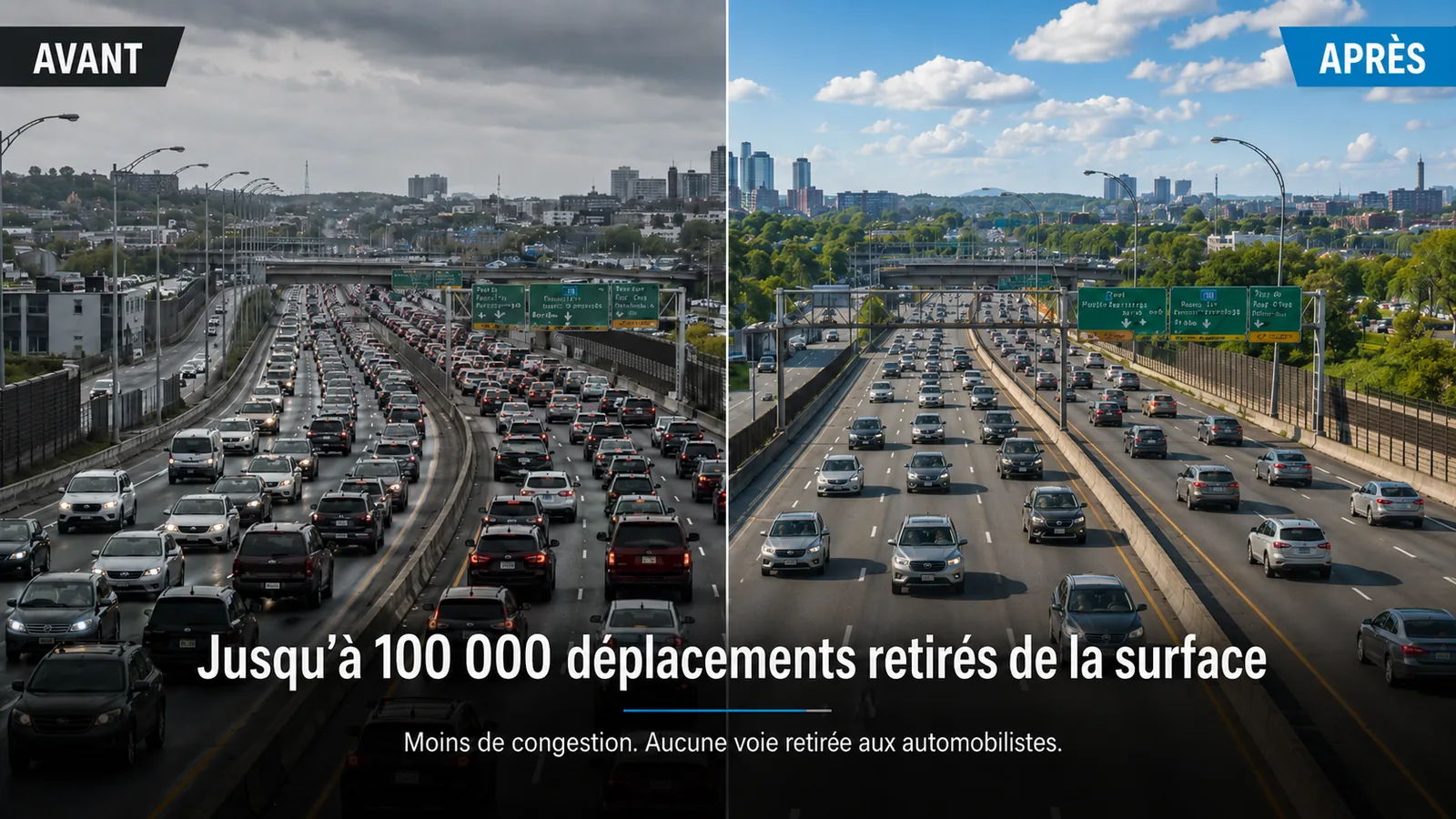
And unlike surface bike lanes, this capacity is added without subtracting anything: no converted lane, no street turned one-way, no parking turned into a bike strip. The “bikes versus cars” debate disappears, because each now has its own level.
Bikes go down, the street stays yours
- No more cyclist to pass while holding your breath on a narrow boulevard.
- No more bike in your blind spot, no more dooring risk: the dread of hitting someone disappears.
- Bikes park underground, in the stations — not chained to the posts along your street.
- Bike–car coexistence no longer has to be negotiated intersection by intersection: it’s settled at the source.
The second car becomes optional
Picture a typical morning in many families: one parent has to drop the young kids at daycare or school, and the car is needed for that. Today, the other parent needs a second car to get to work at the same time. With the tunnel, that second trip is made by bike, rain or shine, at 10 °C year-round, with no snow or ice. One car is enough.
And a second car is no small expense: according to the CAA-Québec calculator, owning a popular model costs about $8,500 to $9,700 a year — depreciation, insurance, registration, maintenance, winter tires, fuel, parking. Selling it is the equivalent of an $8,000–10,000 after-tax raise every year, with no negotiation with the boss. And it’s also one fewer car parked on the street and one fewer driveway to clear of snow.
The end of the “parent taxi”
Many car kilometres aren’t trips you want to make: they’re lifts. School, hockey practice, music lessons, the summer job, a friend’s party… With a safe underground network open 24 hours a day, 365 days a year, teenagers get around on their own:
- They get to school in any weather — storm, freezing rain or heat wave, the tunnel doesn’t know the forecast.
- They come home from their activities without a parent playing evening chauffeur.
- No licence, no fuel, no waiting for a bus in the cold.
And the notorious 2 a.m. ride home? The tunnel is lit, ventilated and monitored along its whole length, with emergency call points: your teen gets home safely, without walking alone through empty streets, without texting “come get me” — and without anyone having to get dressed to pull the car out at midnight. A bonus for every other driver: it’s also one fewer tired or rushed driver on the road at night.
What’s in it for you, concretely
🚦 A rush hour that breathes
- Up to 100,000 trips taken off the surface
- Fewer cars at the same hours = shorter lines at lights and bridges
- Faster, more predictable car trips
🅿️ Parking that frees up
- Fewer second cars in households = more open spots on the streets
- Bikes park underground, in the stations, not on sidewalks or at posts
- Fewer long-term parked cars near schools, arenas and downtown
🛣️ Zero lanes sacrificed
- No lane or spot converted into a bike path: the street stays 100% for cars
- No new lights, islands or curbs to complicate driving
- The only cycling project that takes nothing from you — a true bike–car win-win
😌 Less stress behind the wheel
- No more cyclist in your blind spot or tight passing manoeuvre
- No more fear of opening your door at the wrong moment
- Driving becomes simple again, especially in winter when the road narrows
🚧 Pavement that lasts longer
- Fewer vehicles = less wear, so fewer potholes and orange cones
- The tunnel needs no snow clearing: plows and abrasives stay focused on your roads
- Road budgets that get some breathing room instead of chasing repairs
❄️ A 12-month-a-year ally
- Cyclists don’t come back to clog the roads from November to April: the shift is permanent
- On a stormy morning, every tunnel user is one fewer car to dig out ahead of you
- You keep your car for the trips where it shines: the weekly groceries, the cottage, long hauls
Scenes from real life
| The situation | What the tunnel changes |
|---|---|
| 7:45 a.m. — one parent drops off the little ones, the other has to leave for work | The second parent leaves by bike through the tunnel. The second car — and its $5–8k a year — becomes unnecessary. |
| 4:30 p.m. — bumper to bumper on the boulevard | Some of the people ahead of you are now rolling ten metres below. The line gets shorter. |
| 9:30 p.m. — the teen finishes practice, it’s pouring rain | They come home through the tunnel, dry. Nobody pulls the car back out. |
| 2 a.m. — the party’s over | A lit, monitored ride home, no call to the parents — and one fewer tired driver on the road. |
| Saturday noon — hunting for a spot downtown | Fewer second cars and bikes parked underground: more open spots for those who really need them. |
| Morning after a storm — two cars to clear in the driveway | Only one car to dig out. The other household member is already gone, warm, underground. |
You change nothing about your habits — and you still come out ahead. Nobody is asking you to sell your car or take up cycling. Keep driving exactly as you do today: the tunnel works for you by taking traffic off the road ahead of you, freeing up parking and keeping the street intact. And the day you feel like trying the network, it’ll be there, at 10 °C, with no headwind. Until then, safe travels — and smoother ones.