Phosphorescence is not there to light up the tunnel. It is a last-resort safety net : if the Hydro-Québec grid, the backup generator and the emergency lighting all fail at the same time, glowing lines remain visible on the ground to guide the evacuation — with no electricity at all.
The marking is charged continuously by the LED lamps during operating hours. In the event of a total failure, it releases that stored light. What it shows is exactly what you need to get out : the direction, and the distance to the next exit.
No power supply, no moving parts, no active maintenance — a layer of safety that works precisely because everything else has failed.
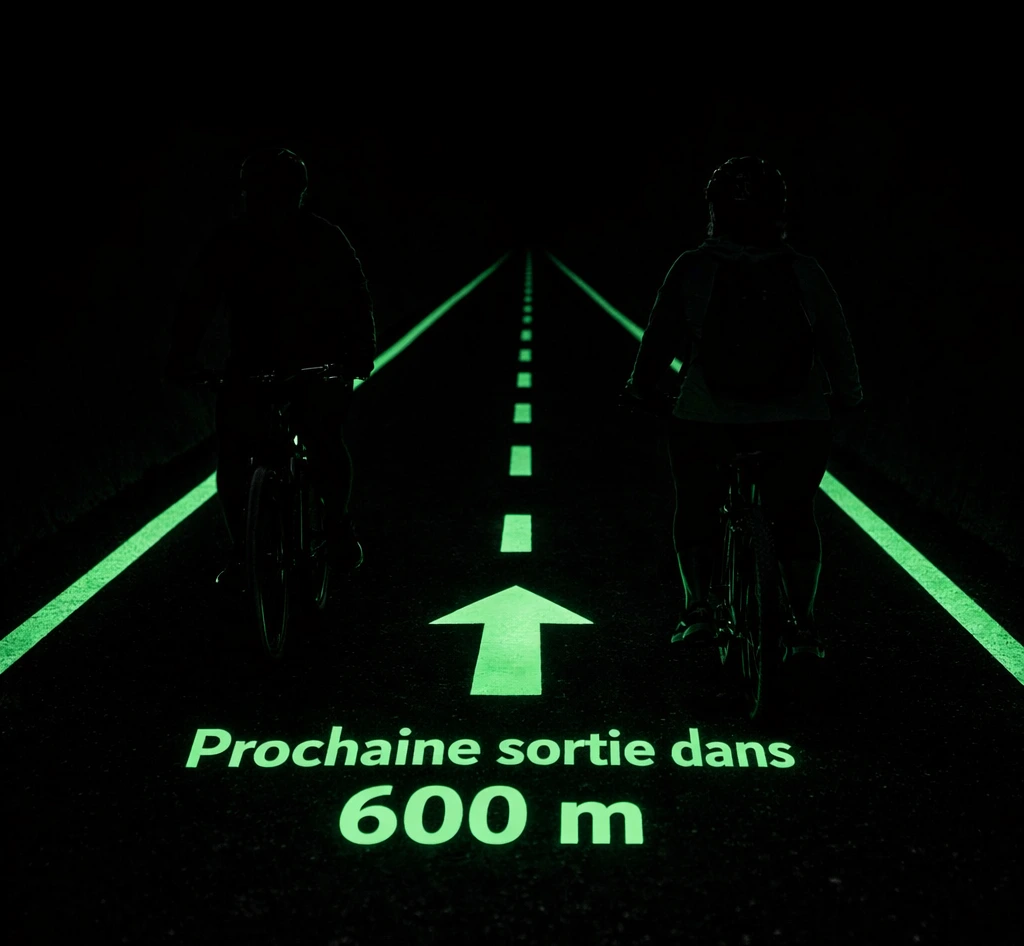
Why the lines stay visible for hours
It is the same phenomenon as the glow-in-the-dark stars on a child's bedroom ceiling. In complete darkness, the eye adapts : after twenty to thirty minutes, the retina becomes thousands of times more sensitive, and the yellow-green of the phosphorescence lands right on the colour to which night vision responds best. A glow that seems “faint” becomes perfectly readable — and stays that way all night : bright at first, then softer, exactly the way the stars on the ceiling fade toward morning without ever going out.
Guidance, not a floodlight. You see the lines, not the whole floor. That is more than enough to walk or ride slowly toward an exit in complete safety — it is not meant for riding fast while lighting up every detail of the roadway. That is exactly the role of evacuation lighting, and it is why green is chosen : the colour of night-time safety.
How it works in the tunnel
In normal operation, the LEDs are on : the tunnel is lit like any other tunnel, and you do not perceive the phosphorescence — it is drowned out by the light while charging continuously. It is the same effect as bedroom stars that disappear the moment you switch on the ceiling light.
During a total failure, the lamps go out, the eye adapts to the dark, and the lines — charged all day — take over. With a quality pigment (strontium aluminate), the bright phase comfortably covers the time needed to evacuate a section, and a residual glow then lingers for several hours.
The LEDs light the tunnel ; the paint recharges, masked by the light.
Bright enough to calmly evacuate any section of the network.
Fading residual glow, still perceptible in the dark.
A code-compliant practice — not an experiment
Photoluminescent wayfinding marking is a recognized safety technology, and even mandatory in comparable buildings. Its reason for being fits in one sentence : when the lights go out, you have to be able to find the exit.
After September 11, 2001 — when this type of marking helped the evacuation of the World Trade Center towers — New York adopted Local Law 26, requiring photoluminescent marking in every stairwell of office towers. The principle is now written into the International Building Code, the International Fire Code and NFPA 101 (Life Safety Code), governed by dedicated standards : ISO 17398, ASTM E2072, UL 1994. The same passive net is found in the stairwells of skyscrapers, on passenger ships and on airliners — for exactly this scenario : everything electrical has failed.
The benchmark in the codes : 90 minutes. These passive devices must stay visible for about 90 minutes after the power is cut. Our target of “about 1 hour” sits within the same range — deliberately conservative, as it should be when it comes to safety.
Already proven on real roads and paths
There is nothing experimental about phosphorescence in the field. In Australia, the agency Transport for New South Wales installed photoluminescent marking (“Glow Roads”) on the Princes Highway, on the descent of Bulli Pass, a hairpin bend with a dangerous reputation where street lighting is not practical.
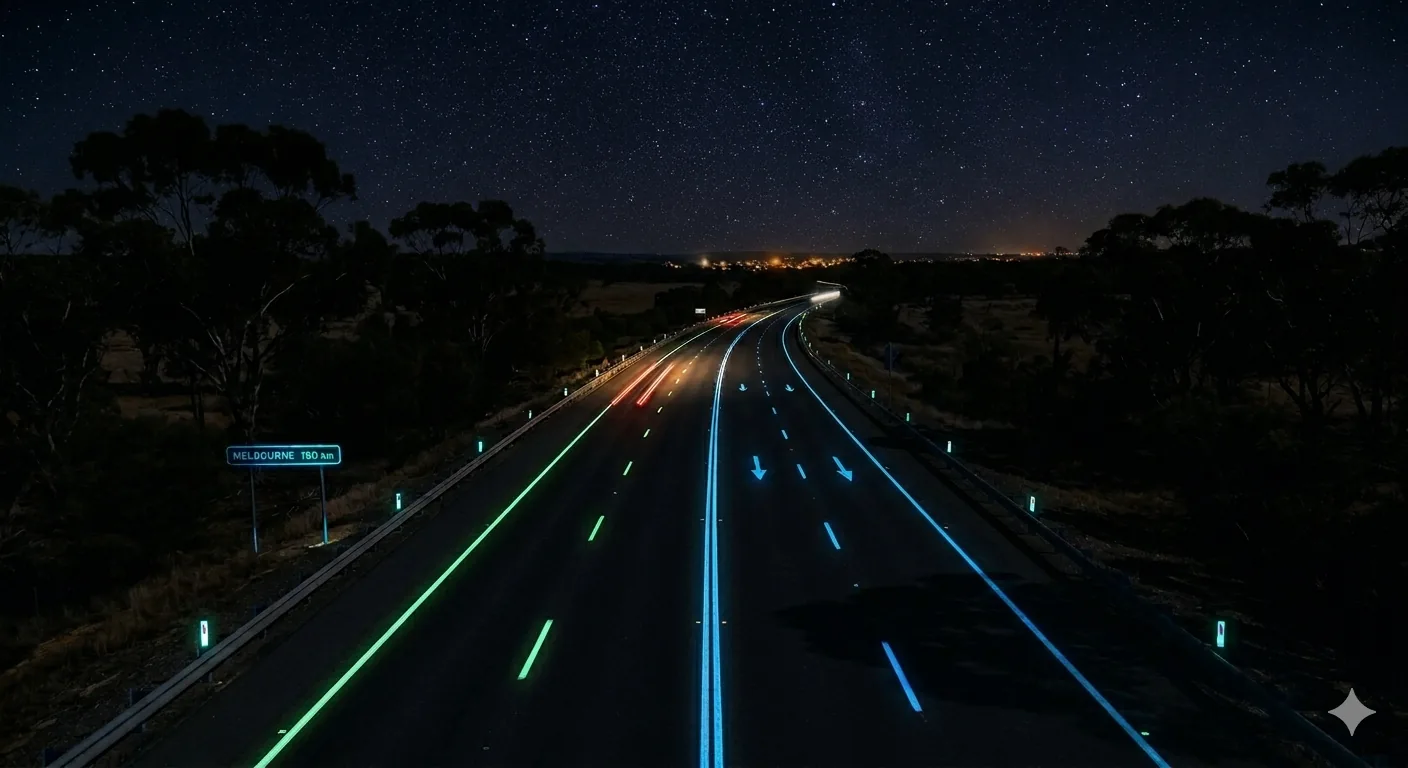
−67 % near-collisions at night
That is the drop measured by Transport for NSW at the end of a six-month trial (December 2024 to July 2025). 83 % of drivers also reported “greater peace of mind” at night — and the agency is now studying extending the marking to other high-risk roads in the state.
Source : Transport for NSW — “Glow Roads” trial, Bulli Pass (Princes Highway).
For cycle paths, there is even a proven and certified product : LuminoKrom (Eiffage Route, France), in use since 2018, designed for unlit cycle and pedestrian paths, recharged by natural or artificial light and glowing for about ten hours, with no power supply at all.
The tunnel : an ideal environment. A road trial in Malaysia was abandoned because the paint degraded in the tropical climate (UV, heat, monsoon, heavy traffic) and was expensive per square metre. Yet in a Québec bike tunnel, none of these factors exist : no sun and no UV, no rain, a cool and stable temperature, and bike traffic that barely wears the surface. Durability is therefore markedly better than on an exposed road.
Designed for a real evacuation
Two principles guide the layout. First, directional information takes priority : in an emergency, what matters is “which way, and how many metres to the exit” — which is exactly what the marking shows (arrows and distance to the next exit). Then, smoke : an underground incident often means fire. Because the intensity of phosphorescent marking is lower than that of active lighting, a low band along the walls stays perceptible longer than lines in the centre of the roadway alone once smoke rises. The marking thus complements the smoke locks and evacuation niches already planned across the network.
What it costs over 150 km
The marking — two edge lines, a centre line, arrows, pictograms and “exit in X m” markers — represents about 45,000 m² of painted surface across the whole network. At the observed installed cost (material + primer + application + protective coat), this places the initial investment between $5M and $12M — an amount already included in the “LED lighting + nature projection” line of $180M in the overall budget.
| Item | Assumption | Amount |
|---|---|---|
| Surface to mark (150 km) | ≈ 0.3 m² per linear metre | ≈ 45,000 m² |
| Installed cost | $80 to $230/m² | — |
| Initial investment (central) | ≈ $150/m² | ≈ $7.7M |
| Planning range | depending on marking density | $5–12M |
| Operating electricity | recharged by the LEDs | $0 |
| Reapplication | rare (tunnel, bike traffic) | multi-year cycle |
The full analysis — calculation method, detailed construction and operating costs over 150 km, standards, sources and comparables — is available for download :
Phosphorescence analysis — PDF
The honest nuance. On a road, the marking is recharged by the sun and serves as a permanent reference at night. In a tunnel, there is no sun : the paint is recharged by the LEDs during normal operation. It therefore does not replace the main lighting — it acts as a passive safety net dedicated to evacuation, for the time it takes for everything to come back. Same physics, use adapted to the tunnel.
Main sources. Real-world examples of photoluminescent bike paths — LuminoKrom / OliKrom: official page (paint that glows for up to 10 hours, without electricity or CO₂), cost of about €4,000/km versus €200,000 to €400,000/km for street lighting, and Vélo & Territoires (standardized performance, ISO 17398 class, IFSTTAR measurements).