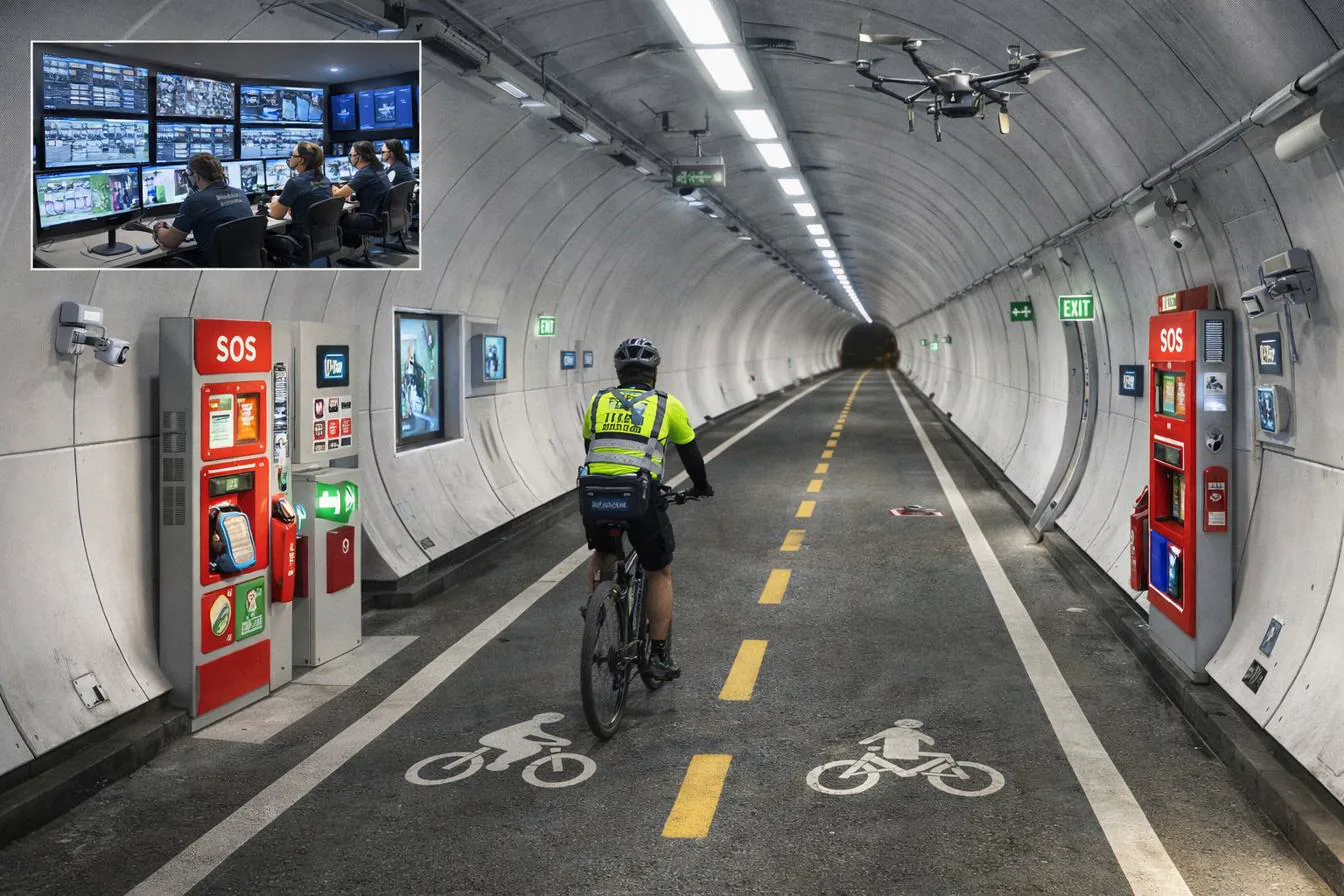
Safety infrastructure
- Cameras every 100 m + densification at intersections
- Emergency posts every 100 m
- Full equipment per post: SOS phone, AED, fire extinguisher, repair kit, silent button
- WiFi/5G + mobile app + radios for staff
- 24/7 control centre with 10 operators and AI
- Emergency exits (shafts to the surface) every ~300 m
- Smoke locks every 500 to 1,000 m
- Refuge niches every 100 m
- Cycling patrols + drones
- Air-quality sensors every 200 m
- Ventilation, LED lighting + backup generators
Active patrol
50 patrollers on bikes during peak hours — one every 3 km. Recognizable by their fluorescent-yellow gear. E-bikes capable of reaching 40 km/h, equipped with a siren (adapted to the tunnel's acoustics) and a flashing light.
Response anywhere on the network in under 3 minutes.
Graduated intervention procedure
If a user slows traffic too much:
- An operator asks them, via a targeted voice announcement, to pull over to the side.
- If the user doesn't comply, a patroller reaches them within minutes to personally accompany them.
This graduated approach resolves 95% of situations without confrontation — no repressive surveillance, just a professional service to keep the network smooth and safe.
The scenario that drives the entire design
Day to day, safety in a bike tunnel is easy: no combustion engines, no exhaust fumes, moderate speeds. The system isn't designed for the everyday — it's designed for the rare but serious event: a lithium-battery thermal runaway (e-bike or e-scooter). The power of such a fire stays well below that of a car, but its smoke is dense, toxic and arrives fast. And the real difficulty, in a single bidirectional tube, is that users downstream of the source end up on the wrong side of the plume.
Three measures answer this scenario together: closely spaced escape shafts to the surface, smoke locks that compartmentalize the tube, and ventilation able to push the smoke to one side only. Here is how each works — and what it costs.
Why our shallow depth changes everything
A conventional metro runs 30 or 40 m underground. At that depth, it is impossible to place an exit to the surface every 300 m: it would be too deep and too expensive. That's why such tunnels must dig a second parallel safety gallery to evacuate into. Our network, by contrast, runs at about 10 m. An emergency exit then becomes a simple short stairwell — the equivalent of three storeys — topped by a small headhouse at the surface. The shallow rock cover, which adds to the cost elsewhere, pays us back here.
✓ The chosen approach: short shafts + locks
- Exits to the surface every ~300 m, made possible by the shallow depth
- Smoke locks that isolate each section of the tube
- No extra boring: the machine isn't enlarged
- Controlled cost, built into the construction budget
Ruled out: a second parallel tube
- Standard for deep road tunnels, where reaching the surface is impossible
- Would double the excavation and much of the cost
- Pointless here: at 10 m, the stairwell to the surface replaces the neighbouring tube
- An option assessed honestly, then set aside
The escape shafts
One emergency exit across the whole network.
Across 150 km of tunnels.
Existing stations + ventilation shafts.
Dedicated escape shafts.
The network already has many exit points: about 150 stations (one per kilometre) and some forty standalone ventilation shafts — nearly 190 surface accesses. To reach an exit every 300 m, roughly 310 dedicated escape shafts remain to be bored. At 10 m deep, each is a stairwell with a headhouse plus land acquisition: on the order of $1 to $4M apiece depending on the urban context, with a central value of about $2M.
| Step | Calculation | Result |
|---|---|---|
| Exit points required (1 / 300 m) | 150 km ÷ 300 m | ~500 |
| Points already available | ~150 stations + ~40 ventilation shafts | ~190 |
| Dedicated escape shafts to add | 500 − 190 | ~310 |
| Unit cost (10 m stairwell + headhouse) | range $1–4M, midpoint $2M | ~$2M |
| Gross cost | 310 × $2M | ~$620M |
| Already budgeted (the “exits” share of the $350M line) | — | ~$100–150M |
| New net cost | — | ≈ $0.5B |
The smoke locks
Frequent exits aren't enough: the smoke must also be kept from filling the whole tube at once. That's the job of the smoke locks — partitions installed every 500 to 1,000 m that divide the 150 km into cells that can be isolated. A battery fire then stays confined to a single cell: users in that section leave through the nearest shaft, while those in neighbouring cells stay clear of the plume and carry on.
What makes a single tube survivable is compartmentalization — not the absence of fire. The combination of “isolated cell + exit at ~300 m” guarantees that no user is ever far from breathable air and a way out. This item is already included in the “Fire suppression + emergency exits” line of the construction budget.
Smoke: pushed to one side only
Backing up the locks, ventilation plays its emergency role: the jet fans already installed ramp up to push the smoke in a single direction, at the critical velocity of about 2.5 m/s, keeping the other side breathable long enough to evacuate. It is in fact this requirement — not everyday air quality — that sets the fans' power. The full calculation is on the Ventilation page.
What the world's only comparable network teaches us. The Boring Company's Loop in Las Vegas — a tunnel system for cars — was initially criticized for how few evacuation features were actually built in: little exit signage, few refuges. In May 2026, Clark County had to adopt a regulation to require evacuation procedures, emergency ventilation, water-based suppression and a minimum spacing of emergency exits. Two lessons: egress is never “included” by default, and it is always better designed from the outset than retrofitted. And our case is simpler still — a 10 m tube for bikes, with no electric rail or combustion engine.
Sources: Las Vegas Review-Journal and KTNV (coverage of Clark County's safety regulation, 2026); “Vegas Loop” article, Wikipedia (2026 updates). The Loop carries Teslas in two separate tubes; our network is a single bidirectional bike tube, hence a different evacuation strategy.
The safety of women and people travelling alone
This is the most common objection to an underground network: being alone in a tunnel, especially at night, especially for a woman or a child. It deserves a frank answer, not a slogan. And the honest answer is that a controlled, lit, monitored environment with no anonymous way out is safer than a random dark street.
The reason lies in an attacker's own logic. In a linear tube, 100% covered by cameras, with no alley or street corner to vanish into, anyone who attacked someone would be filmed, identified and cornered, with no way out. It's the same reason an assault by a stranger is extremely rare on a monitored aircraft: no exit, visible from everywhere, certain consequences. The tunnel reproduces exactly that trap.
✓ An exit that protects the victim…
- Opens via a panic bar that triggers an alarm
- Immediately swings the cameras over and alerts the control centre
- Comes out at the surface in a lit, public place — never an alley
- Someone fleeing gets out fast — and is seen
…and that traps the attacker
- Opening it exposes him instead of hiding him
- Alarm + cameras + an exit in full light in front of everyone
- No “anonymous” exit: only controlled exits
- Frequent exits help the one without serving the other
Two clarifications make the argument watertight rather than overstated. First, a camera is above all evidence: it deters the rational attacker and helps track him down, but it doesn't stop him in the moment. What protects in the instant is physical intervention — and the network guarantees a patroller anywhere in under 3 minutes, backed by drones and SOS posts every 100 m. Second, the real barrier to off-peak use isn't rare, serious crime — it's ordinary unease: the person who follows another without touching them. So we design for that too.
Glazed, frequent stations: never more than ~500 m from a populated entrance.
SOS posts and a silent button always within reach.
No blind spots, permanent lighting.
Patrollers and drones everywhere on the network.
Honest about perception. Objectively, the network beats the dark street. But feeling drives adoption: at 3 a.m., when the tunnel empties, the “crowded = safe” effect fades. That's precisely where the design relies on response time, constant lighting, closely spaced staffed stations and the option to concentrate off-peak activity. The safety of people travelling alone is a deliberate design priority — not a box ticked in advance.
The trap closes on the attacker — not on you.
A lit, filmed, patrolled tube with no anonymous way out turns the attacker's usual advantage — shadow and escape — into a handicap. It's the exact opposite of a deserted street.
Main sources. Fire safety of the tunnel system — the Music City Loop meets or exceeds the NFPA-130 standard (real-time gas and smoke detection, redundant ventilation), The Boring Company. See also the press coverage already cited on this page (Las Vegas Review-Journal, KTNV).