Underground, beauty isn't a luxury: it's what decides whether people go down or not. But it has to come from above. We simulate the sky over the full 150 km — and we deliberately leave the walls as bare concrete. Here's why, what we gain, and what it costs.
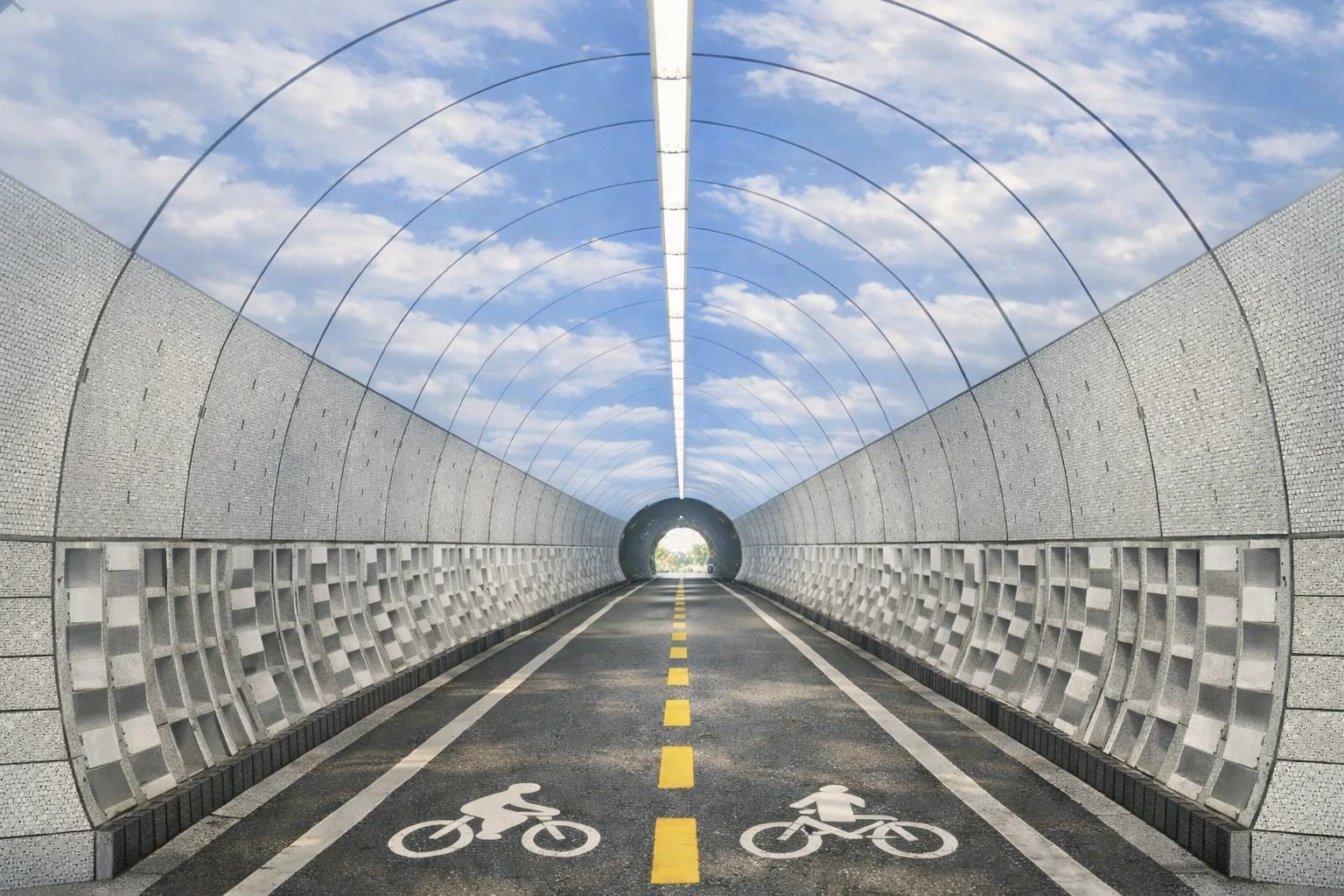
Why we're dropping the forest on the walls
This site long argued for printing a forest onto the tunnel walls. We've changed our minds, and it's better to say so plainly than to let a beautiful rendering hide a real problem.
The problem is speed. A cyclist rides at 25 or 30 km/h, and the wall sits a metre and a half from their eye. At that distance and that speed, detailed scenery isn't something you “look at”: it sweeps through peripheral vision as one continuous blur. The eye then reports violent motion that the inner ear doesn't confirm — precisely the conflict that produces motion sickness: nausea, headache, fatigue.
And unlike a car passenger, a cyclist can't rest their gaze on a stable horizon: underground, there isn't one.
Three aggravating factors settle the question. The trip is long: we're not talking about ten seconds of tunnel, but tens of minutes of continuous exposure. The space is confined: no stable vanishing point to anchor the eye. And the movement was meant to be amplified by projectors animating the walls — in other words, we were deliberately adding motion to scenery that was already streaming past.
So the layer meant to make the tunnel pleasant was the one most likely to make it unpleasant. A cyclist who's felt sick once doesn't come back down. Better a plain wall nobody notices than magnificent scenery that empties the tunnel.
The sky is enough — and it's the part that matters
The good news is that the layer that really does the work was never the forest. What defeats claustrophobia is looking up and seeing sky: light, height, a visual way out overhead. That's the layer we keep — and the one we can now afford to do far better.
The vault has a decisive advantage over the walls: it's far, wide and above you. What happens up there crosses central vision slowly, instead of sweeping through peripheral vision at full speed. A sky doesn't “stream past” the way a wall does — which is exactly why we can afford to simulate it.
🫁 Claustrophobic people
- Anxiety isn't only felt at the entrances: it lasts the whole trip.
- A luminous sky overhead dissolves the sense of a low ceiling.
- It's the layer doing the most work — and it stays untouched.
🤢 People sensitive to motion
- A significant share of the population is susceptible to motion sickness, to varying degrees.
- Nothing streams past at eye level: the wall is plain, matte and neutral.
- We remove that risk at the source rather than patching it afterwards.
🌿 Lovers of the open air
- What they're after is the feeling of being outdoors — not wallpaper.
- Sky, shifting light, moving air and light sound: the essence of “outdoors” is in those four things.
- Real plants stay, at the stations and the portals.
🌍 A source of global pride
- No city offers riding under a summer sky in the middle of January.
- World's first network of its kind: identity, tourism, international coverage.
- A symbol Québec would talk about — and that the world would talk about.
The sky we're aiming for isn't quite the one in the image
The image at the top of this page illustrates the principle — luminous vault, bare walls — but it doesn't show the right sky. It has a lot of clouds, small and sharply separated. Applied as-is over 150 km, that sky would reproduce a milder version of the very problem we just eliminated: each cloud would become a distinct object passing overhead, then another, then another. Slower than on the walls, but still a stream of things going by.
The real sky will therefore be emptier and more stretched out. Two rules:
- Fewer clouds. Large expanses of clean blue, with sparse cloud rather than a busy sky. What isn't there can't stream past.
- Clouds stretched along the tunnel axis. Instead of compact puffs crossing the field of view, long formations oriented longitudinally, parallel to the direction of travel, running for hundreds of metres. Riding beneath one, you don't see it “go by”: it accompanies the trip and changes slowly.
Edges are softened, contrast is kept low, and transitions from one mood to the next are spread over kilometres. The result is a sky less photographic than the one in the image, but one that keeps the essential promise: light and height, without ever giving the impression that something is passing over your head.
The technology, in four layers
The setup gets much simpler. The first three run the full 150 km; the fourth concentrates the “wow” effect where it can do no harm — the stations, where you're standing still.
LED-backlit vault in “tunable white” plus a colour layer: clean blue by day, warm at dawn and dusk. It's the antidote to claustrophobia — and it doubles as general lighting.
Smooth concrete in light, uniform tones, with no pattern or image — the acoustic treatment of the walls has its own dedicated budget. Nothing to fix your gaze on, nothing streaming past. It's also the toughest and cheapest surface to maintain.
A light sonic backdrop — breeze, distant birds — synced with the ventilation air. Sound has no streaming effect: it immerses without ever causing nausea. Low volume, and subject to validation by the study.
That's where rich scenery belongs: at the stations you're stopped or moving at walking pace. No speed, so no visual conflict — video mapping, screens, real plants, a high-end sky.
The key isn't realism, it's pace. A very simple luminous vault that evolves slowly does the job better than a photorealistic scene sweeping through your field of view. We've shifted the effort from the amount of detail to the speed at which that detail changes.
What about habituation?
The objection is real: faced with a perfectly constant backdrop, the brain eventually stops “seeing” it, and the feeling of confinement can creep back in through the back door. The answer is no longer to vary the walls, but to vary the sky.
Along the network, the vault changes colour temperature, apparent height and cloud density — but over scales of kilometres, not metres. It also tracks the real time of day: bright blue at noon, golden late in the afternoon, starry in the evening. The variety is genuinely there, and it re-engages attention; it's simply too slow for the eye to read as motion.
The rule, in one sentence: anything that changes must change more slowly than the cyclist advances. That single criterion is what separates a pleasant atmosphere from a tunnel that makes you queasy.
Lasting 50 years
Choosing bare walls makes durability far simpler: there's no longer a fragile image at hand height, and no projectors to recalibrate over 150 km. What's left to protect is handled by height and by materials.
- Contact zone (0 to 2.4 m): smooth concrete or acoustic blocks, hard and washable, covered with a sacrificial anti-graffiti film. If it's marked or scratched, you replace the film cheaply — not the wall.
- The vault (2.4 m and above): out of reach, never touched. That's where the entire simulation lives, with no risk of damage.
- All modular: a failed sky panel is replaced on its own, without disturbing the rest.
- Fewer wearing parts: maintenance now concentrates on the vault and the stations, instead of spreading over kilometres of printed surfaces.
The king of materials is still useful: porcelain-enamelled steel has equipped subways for a century. Graffiti wipes off, it's 100% non-combustible, it lasts over 50 years maintenance-free. We now reserve it for the stations and the busiest sections, where walls take the most abuse.
What it costs: $420M
The envelope is tightened to the essentials. What we no longer spend on the printed forest and the movement projectors goes back into a far better sky across the 150 km and into the stations. One major item, moreover, leaves this table: the acoustic treatment of the walls, which has its own dedicated budget (≈ $450M in the cost dossier) and therefore doesn't belong here. The “Walls” line below now keeps only what genuinely belongs to the nature simulation: smooth light concrete and an anti-graffiti film.
| Layer | Scope | Budget |
|---|---|---|
| Luminous sky, high specification | 150 km, everywhere | $210M |
| Walls: smooth light concrete + anti-graffiti film (acoustics budgeted separately) | 150 km | $30M |
| Discreet soundscape | 150 km, everywhere | $40M |
| 150 stations all polished | each station | $100M |
| Showcase segment + signature stations | the showcase | $20M |
| Reserve + enhancements (partly sponsorships) | — | $20M |
| Total | $420M |
For perspective: $420M on a roughly $12.7B project is about 3.3%. This isn't decoration an opponent could ridicule — it's the investment that guarantees the tunnel is used, and so protects the value of the remaining 97%. (Orders of magnitude to be refined with real bidders.)
What would blow up this figure is spreading dynamic video screens over the full 150 km: then we'd be talking over a billion, plus electricity and lifetime maintenance. The strategy avoids that twice over — the expensive dynamic stuff stays at the stations, where the surface area is tiny, and the walls along the 150 km no longer carry any scenery to maintain at all.
A world first
No city in the world offers riding under a blue sky, sheltered from cold and wind, in the middle of January. It isn't a forest — and for a cyclist actually moving, it's better: light, space overhead, and nothing tiring the eye over 150 km. The planet's first underground cycling network with a simulated sky would give Québec a unique identity: a magnet for tourism, talent and international media coverage, far beyond its simple transport function.
That's what we protect by investing in the sky rather than the walls: not a backdrop, but the very reason hundreds of thousands of people will want to use it — and to come back.
The option we're setting aside
Here's what the original ambition looked like: a boreal forest printed from floor to vault and, further along the network, a seashore opening onto the horizon. These images are still beautiful — which is exactly why we're leaving them here rather than deleting them.
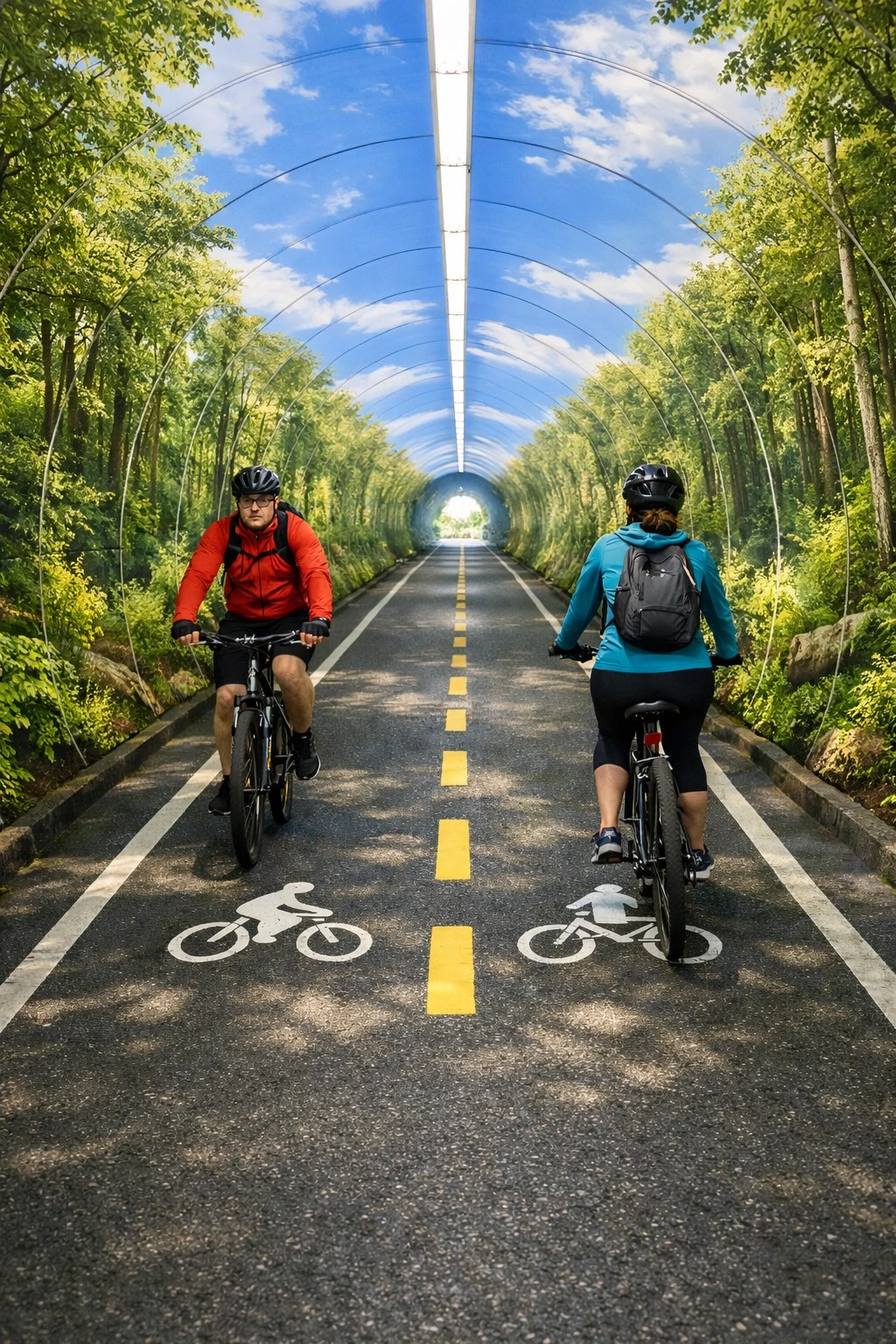
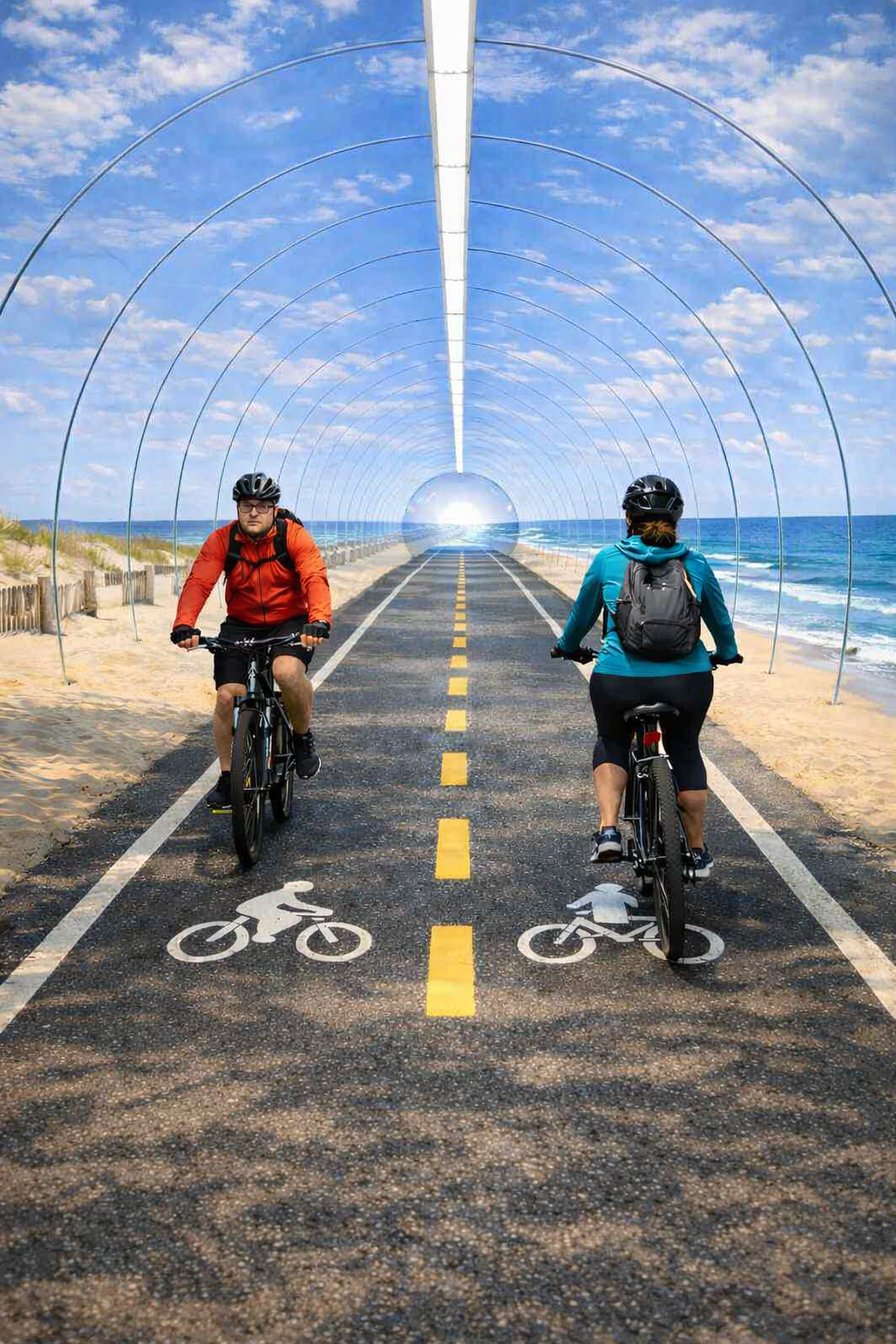
Is it gone for good? Not necessarily. If the study found a way to render this kind of scenery without triggering motion sickness — far softer patterns, very low contrast, scenes stretched along the tunnel axis as well, or use restricted to stretches where riders go slowly — we could reintroduce a version of it over a few kilometres. But we doubt it. The conflict between the cyclist's speed and the closeness of the wall is structural: it isn't solved by turning down the saturation. Until then, these two images stay what they are — a lovely idea that honesty obliges us to shelve.
Main sources. This page draws on our detailed analysis: download the analysis (costs of the nature simulation) (PDF). Note: that document costs out the full immersive scenario — the one we set aside here. The envelope we keep is now $420M: we drop the printed forest in favour of the sky and the stations, and the acoustic treatment of the walls is pulled out of this total because it has its own budget in the cost dossier.