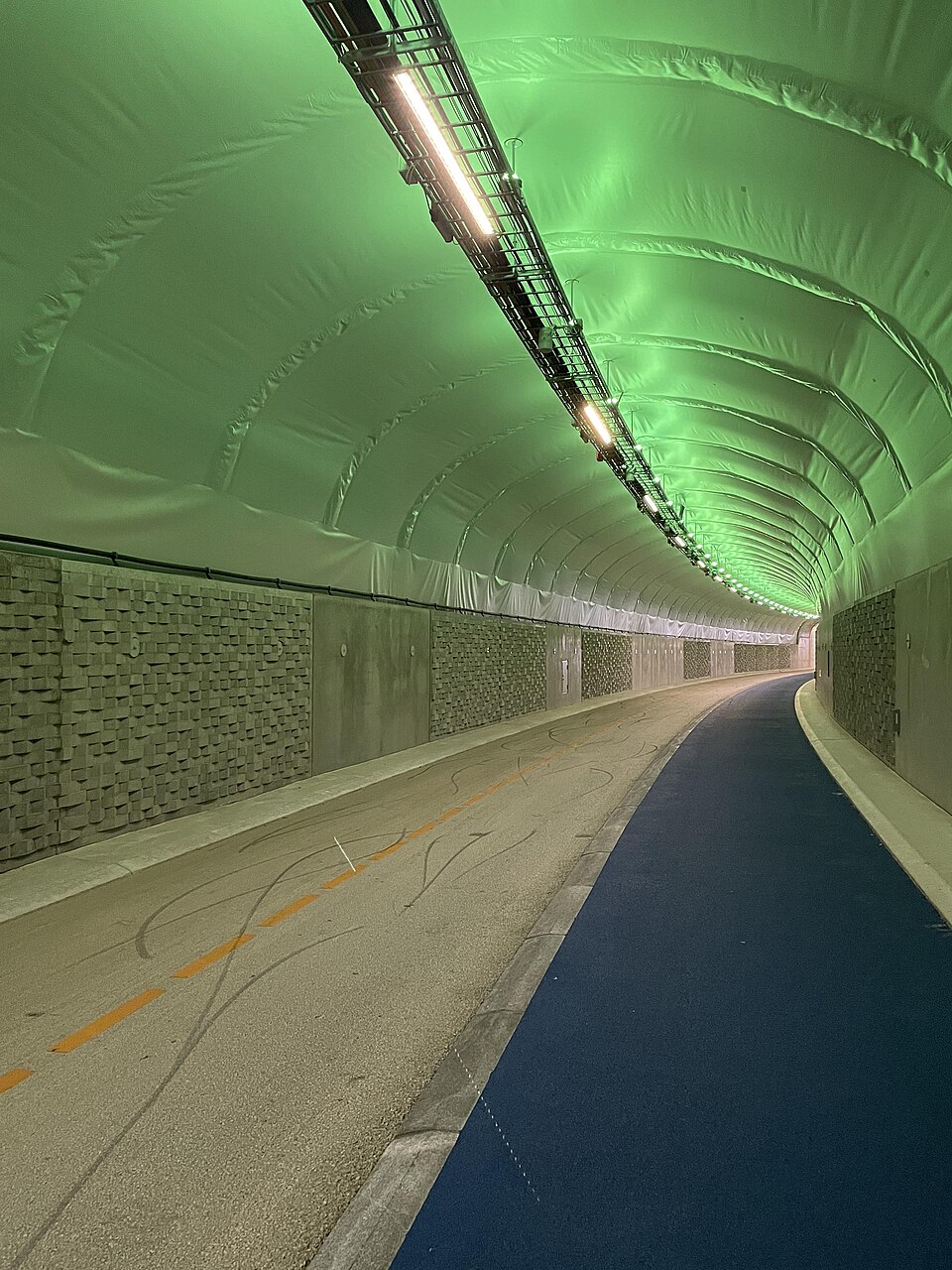
2.9 km under the Løvstakken mountain
The Fyllingsdalstunnelen connects the Fyllingsdalen district to the Kristianborg area, near the centre of Bergen, passing under the Løvstakken mountain. Opened in the spring of 2023, it is billed as the longest tunnel in the world built specifically for cyclists and pedestrians : about 2.9 km in a single stretch, which a cyclist crosses in roughly ten minutes.
Inside, a 3.5 m bike lane and a raised 2.5 m pedestrian corridor, continuous lighting, artwork and colourful light effects that pace the journey to break the monotony — a concern we share with our concept of simulating nature — and even a digital sundial that marks the halfway point. A detail that speaks to us : the walls are made of tilted concrete blocks to dampen reverberation and echo, exactly the issue we document on our acoustics page. Cameras, emergency phones and rest areas round it all out.
The trick that brought the bill down
The tunnel was not bored on its own : it was built in parallel with Bergen's tramway tunnel (the Bybanen), for which it also serves as an emergency escape gallery. By sharing the worksite and the functions, the city obtained a major cycling infrastructure for a fraction of the cost of a standalone project : about 300 million Norwegian kroner (around US$29 million) for four years of work, according to CNN — roughly US$10 million per kilometre.
This is exactly the logic Bike Tunnel Québec advocates with its other uses : a tunnel that also carries delivery drones, fibre optics or geothermal energy is no longer an expense for a single group of users, but a shared infrastructure.
A harsh climate? Bergen knows about that too
Bergen is famous as one of the rainiest cities in Europe, with more than 200 days of precipitation a year. Inside the tunnel : never any rain, never any wind, never any black ice, and a constant temperature of about 7 °C year-round thanks to the rock mass — the same phenomenon we document on our page about ventilation.
Replace the Norwegian rain with snow, black ice and Québec's -20 °C, and the argument becomes even stronger here : an underground network means the cycling season goes from 6 months to 12 months, with no snow-clearing of the paths.
What Bergen proves — and what it doesn't
Let's be rigorous. Bergen proves that a bike tunnel works day to day : ordinary people use it to get to work, safety and maintenance are manageable, and the experience is pleasant enough that the tunnel becomes a local point of pride rather than a passage people avoid.
Bergen does not, however, prove the scale of the Québec project : 2.9 km is not 150 km of network. This is where The Boring Company's Prufrock technology comes into play : it aims precisely to drive down the cost per kilometre to make large scale conceivable — which we put numbers on in our price comparison.
A precedent, not an exception. Other cities have converted former railway tunnels into cycling passages — like the 3.6 km Snoqualmie tunnel near Seattle. Bergen remains, however, the longest tunnel designed from the outset for bikes — the closest reference to what Bike Tunnel Québec proposes.
Sources and further reading : Euronews (report with video) · CNN Travel · Visit Bergen (official tourism site) · Wikipedia.