A global contest: "propose a tunnel, we'll build it for free"
In January 2026, The Boring Company launched an international contest dubbed "Tunnel Vision Challenge." The idea fits in one sentence: submit your best tunnel idea, and the company will pick one to dig at its own expense. The rules were precise: a tunnel no more than one mile long (about 1.6 km) and 12 feet of interior diameter (about 3.7 m), with proposals due before February 23 and a winner announced on March 23.
The detail that interests us most: the company stated in black and white that the tunnel could be a Loop, a freight tunnel, a pedestrian tunnel, a utility tunnel, a water tunnel "or any other useful purpose." In other words, a tunnel dedicated to pedestrians and bikes was explicitly eligible — and it would have been built for free. The call gathered 487 proposals, narrowed down to 16 finalists.
This is precisely the type of structure we are proposing: a dedicated tunnel, not an underground highway for cars. And we're not the ones inventing it — it's The Boring Company itself that listed the pedestrian tunnel among the acceptable uses.
Panama's project: "The Canal Underline"
The City of Panama submitted exactly the kind of tunnel we picture here: an underground passage of about 0.6 mile (roughly 1 km) that would let people cross the canal on foot or by bike, without mixing with car traffic. Dubbed "The Canal Underline," it would connect Panama City and Panamá Oeste, with parks and public spaces at both ends — conceived as an experience to live, not merely a shortcut. A notable fact: Panama was the only finalist outside the United States.
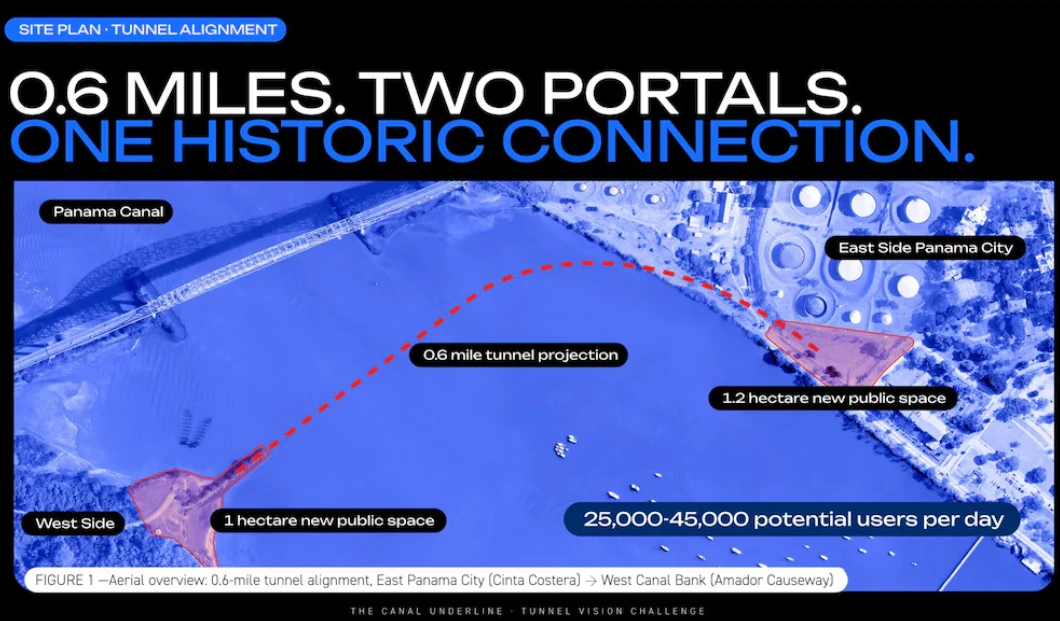
The project was championed personally by Panama's mayor, Mayer Mizrachi, 38, a tech entrepreneur (founder of the encrypted messaging service Criptext). According to him, the idea came from a Boring Company post he saw in January: after visiting the metro tunnel then under construction beneath the city, he wondered why not build a pedestrian crossing under the canal, lined with parks and telling the country's story, its biodiversity and the canal's role in world trade.
A reassuring detail on feasibility: Panama already knows how to dig under its canal. In February 2026, a tunnel-boring machine aptly nicknamed "Panama" finished the Line 3 metro tunnel by passing under the canal, at about 213 feet (65 m) deep. Crossing the canal underground is therefore no longer science fiction.
The crucial point: a pedestrian tunnel, not a Loop to operate
In an interview, Mayor Mizrachi put his finger on what makes his project different from Las Vegas — and it's exactly our argument. In Vegas, The Boring Company operates the network: Teslas, drivers, a daily operation. A pedestrian tunnel, by contrast, is much more "hands-off": the company builds it, period — it doesn't have to run it afterward.
This is the heart of our bet. A bike tunnel is simpler than a Loop: no fleet to manage, no drivers, no system to operate continuously — you ride it yourself. Our how it works and shuttles pages detail this deliberately pared-down operation.
What happened: three winners, none of them a bike tunnel
At the end of March 2026, a twist: rather than a single winner, The Boring Company announced three — the NOLA Loop in New Orleans, the Ravens Loop in Baltimore and the University Hills Loop in Dallas. Two other cities (Hendersonville, Tennessee, and San Antonio, Texas) were also selected for out-of-contest discussions.
Two honest caveats are in order right away, because they matter for our project:
- The winners are not bike tunnels. The three selected projects are Loop-type tunnels — Teslas in a tunnel, as in Las Vegas — not bike paths. The only true bike/pedestrian tunnel in the final group was precisely Panama's.
- Baltimore withdrew the very next day, within the 24 hours following the announcement, after the first discussions. That left only two funded projects.
Panama didn't win — but it's not dead
Panama didn't win the contest. But the story doesn't end there: the City says The Boring Company nonetheless expressed interest in studying the project outside the contest, in a pre-feasibility phase (soil studies, engineering constraints, etc.). In a statement dated March 24, 2026, Mayor Mizrachi indicated that the company remained interested and wanted to deepen these studies, at its own expense, outside the competition, because it considers the project remarkable. As of spring 2026, it is therefore "still on the table," at the study stage.
Two caveats of scale, to stay credible
Before crying victory, two clarifications that directly touch our project.
- The scale is nothing alike. The free offer covered one tunnel of one mile maximum (1.6 km). Our vision is a 150 km network — two orders of magnitude further. No one is going to build 150 km for free; that's exactly why our pages on costs, construction and the without The Boring Company scenario exist.
- "Free" has its limits. The company committed to paying for the tunnel and its basic fit-out; the associated surface infrastructure (Panama's parks, an art piece in a station, etc.) remained to be negotiated. The good news is therefore not "someone's going to build us a network for free" — it's something else, and it's more solid.
Why this is excellent news for Bike Tunnel Québec
Here is the argument, and it's strong. In 2026, The Boring Company itself publicly validated the concept of a tunnel dedicated to bikes and pedestrians: it invited this kind of proposal, offered to build it for free, and is actively studying a concrete case (Panama). That answers in advance anyone who would object that "their tunnels are just for Tesla cars." That's false: they opened the door to bikes themselves. We develop this response in our benefits and critiques and responses pages.
The takeaway. In 2026, The Boring Company moved the bike/pedestrian tunnel from the status of an idea to that of an officially acceptable use: a global contest, a free-construction offer, 487 proposals, and a real cycling project — Panama's — still under study in spring 2026. The announced winners remain car Loops and the free offer is limited to one mile; but the principle itself is settled. A milestone to add to our history.
Sources and further reading: The Boring Company — Tunnel Vision (rules) · Newsroom Panama — "still on the table" · Newsroom Panama — the strategic stakes · Teslarati — the winners · FOX 8 · Tesorb · ECOticias.