One infrastructure, many uses
The hole is dug only once, but it can serve many times over. A refuge sheltered from the weather, and a shared corridor that telecoms and Hydro-Québec can lease to bury their networks. Every added use makes the project more useful — and more financeable.
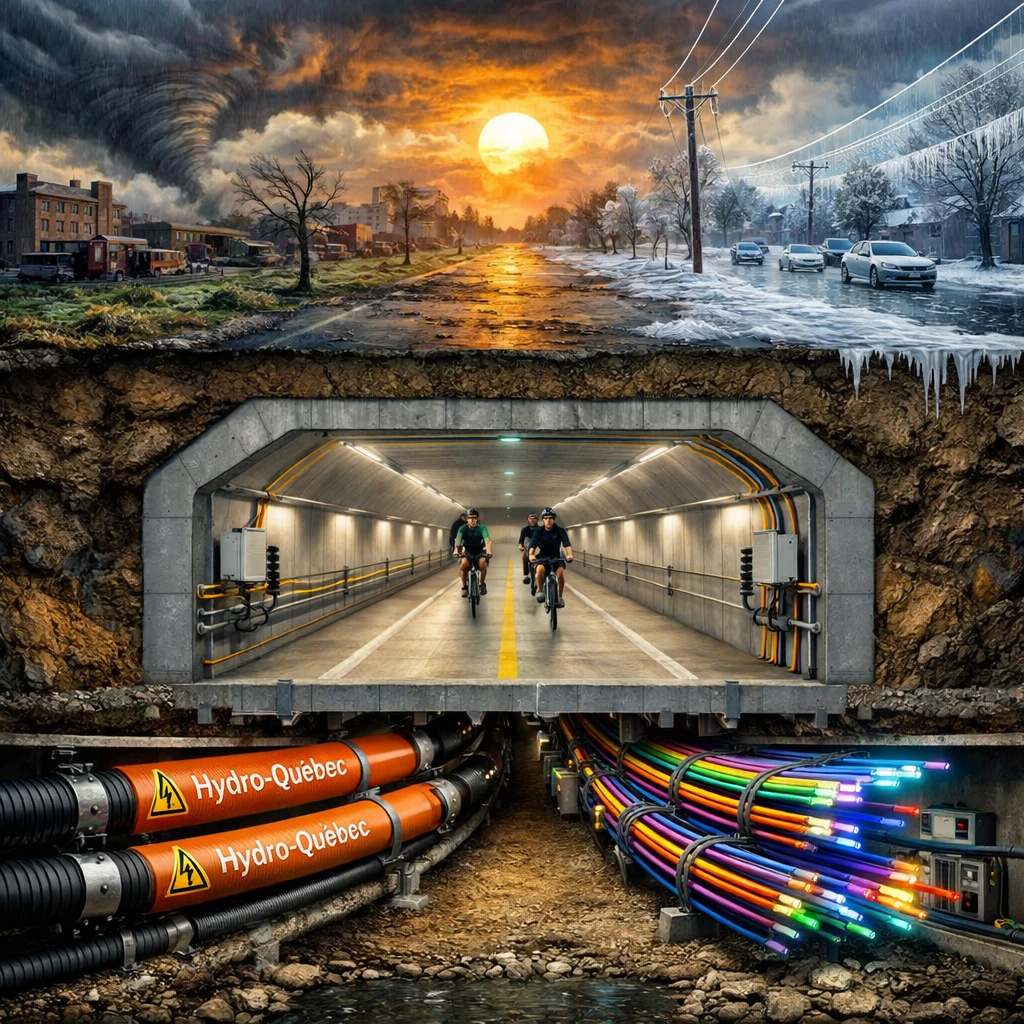
A refuge when the surface turns hostile
A tunnel buried ten metres down does not vanish when the sky unleashes itself. Whether a tornado sweeps away everything in its path, a heat wave makes the air unbreathable, or an ice storm paralyzes the city, the network stays put — stable, sheltered, at a constant temperature. What was dug to carry cyclists becomes, when the day comes, a place of shelter for the population.
The most telling example in Québec is the 1998 ice storm: poles brought down, the power grid on the ground, entire neighbourhoods left without electricity or heat for weeks, in the dead of winter. An underground network, by contrast, keeps running — and stays temperate thanks to the bedrock at 10 °C.
The surface can be flattened; 10 m underground, the tunnel does not move.
The bedrock keeps the tunnel cool when the air becomes dangerous outside.
At 10 m, you never face the −30 °C of the street in January.
Independent of the poles and icy roads at the surface.
The honest caveat. At 10 m, the tunnel offers remarkable protection from the weather — but it is not a nuclear bunker: its depth remains modest and its entrances are its weak points. Its natural role is climate sheltering and resilience, not military defence. To turn it into a genuine civil-protection shelter (blast doors, air filtration, supplies), dedicated fittings would be required — it is possible, but it comes at a separate cost.
A shared corridor for vital networks
The same reasoning that applies to geothermal energy holds here: digging is the item that costs a fortune. Hydro-Québec, the telecoms and the City also have to bury their networks — which means digging trenches, closing streets, and paying dearly. If the tunnel already exists, they save their most expensive part, and the network in return collects a fee that directly reduces the cost for cyclists.
Fibre optics — the simplest gain
Lightweight, no heat, no danger whatsoever to cyclists. Bell, Vidéotron and Telus pay dearly for underground conduits, and a 150 km route running across the whole region is an ideal artery. You lay the cables, and that's that.
Cellular coverage — a necessity that pays
Underground, the surface signal does not reach — exactly as in the metro. The 5G signal must therefore be brought inside the tunnel through small antennas spaced along the route (a system already planned anyway for safety and the app). The carriers want their customers to have coverage across your 150 km: they can host their equipment and pay for that access, just as they do in the metro, in stadiums or in shopping malls.
Hydro-Québec's electricity — in its own enclosure
This is the item with the greatest potential, but the most tightly regulated. High voltage gives off heat and represents a fire load: it is never run out in the open next to the bikes, but rather in a sealed, fire-rated enclosure, or a separate technical sub-gallery, with access reserved for Hydro's crews that does not require closing the path. In exchange, Hydro buries its lines sheltered from the storms — a major resilience asset, especially after the lesson of 1998.
Water and other municipal networks
Water mains, smart-city sensors, even district heating in the longer term: the corridor can accommodate other networks, with the same separation precautions. A path for the future, rather than an immediate promise.
✓ Easy to integrate
- Fibre optics — no conflict, immediate revenue
- Cellular antennas — already needed for safety
- Sensors, telecoms and low voltage
Possible, but regulated
- High voltage — separate fire-rated enclosure mandatory
- Water — flood risk to manage, isolated main
- Any heavy network — maintenance without closing the path
How much could it bring in?
First, the usual warning: these figures are orders of magnitude, not commitments. The actual rates for leasing conduits, hosting antennas or providing an electrical corridor depend on a negotiation with each partner; only a specialized study could pin them down precisely. Here, nonetheless, is a reasonable range, in annual revenue.
| Revenue source | Conservative | Realistic | Optimistic |
|---|---|---|---|
| Fibre optics (conduit leasing) | 2 | 5 | 12 |
| Cellular coverage (antenna hosting) | 1 | 2 | 4 |
| Hydro-Québec electrical corridor (fee) | 1 | 4 | 10 |
| Water & other municipal networks | 0.5 | 1.5 | 4 |
| Annual total ($M) | ≈ 4.5 | ≈ 12.5 | ≈ 30 |
In the realistic scenario, that is roughly $12 to $13 M per year — nearly 7% of the operating budget (~$194 M/yr) covered without asking anything more of cyclists. It does not finance the entire network, but it genuinely lightens the bill, and above all it diversifies it: less weight on users and taxpayers.
The hidden lever: a one-time contribution from Hydro-Québec. Beyond the annual fee, there is a one-off gain potentially far larger. Burying a power line costs a great deal per kilometre. If the tunnel spares Hydro from digging its own trenches over part of the network, the saving for Hydro runs into the tens, even hundreds of millions — which could take the form of a share in the construction cost. This may well be the project's most powerful financial lever… and the most dependent on a negotiation.
And what about civil safety?
The value of a refuge cannot be sold, but it can be financed: a network that protects the population in the event of disaster is also a matter of public safety. It is a strong argument for securing government co-financing — municipal, provincial or federal — that a mere bike path would not justify.
The real double benefit
Beyond the money, routing these networks through the tunnel creates two advantages that reinforce one another.
Resilience. A buried power and telecom network survives the storm that brings down the poles at the surface. The tunnel would no longer be merely a refuge for people — it would protect the vital infrastructure itself. The loop closes with civil safety: during the next major crisis, power and communications would keep flowing where the surface has failed.
Allies. Hydro-Québec, the telecoms and the City stop being mere bystanders: they become partners with a concrete stake in the project's success — and thus co-funders and political backers. This is surely the best way to turn a citizen idea into a project carried forward by institutions.
Key takeaways
- Climate refuge: sheltered from tornadoes, heat waves, severe cold and ice storms — stable and temperate, as 1998 cruelly reminded us.
- Multi-service corridor: fibre (easy), cellular antennas (already needed), electricity (in a fire-rated enclosure), water and other networks.
- Revenue: on the order of $4 to $30 M/yr, ≈ $12.5 M in the realistic scenario — nearly 7% of the operating budget.
- The big lever: a one-time contribution from Hydro-Québec to construction, if the tunnel spares it its own trenches.
- Civil safety: an argument for securing government co-financing.
- Allies, not just tenants: the partners become backers who help move the project forward.
- All amounts are preliminary orders of magnitude; a specialized study would pin down the final figures.