The whole point of a dedicated network comes down to one word: momentum. A bike trip where you almost never stop. On the surface, every intersection imposes a light or a stop — you lose speed, time, and the sheer pleasure of riding. Underground, in three dimensions, we can do what highways do: separate the flows onto different levels. Two tunnels that cross never meet. And when you really do need to change axis, a give-way roundabout lets you do it without ever putting a foot down.
An interchange therefore combines two simple ideas, borrowed from the best of road design and adapted to the bike: the two-level crossing to go straight through, and the roundabout to turn.
1. Straight through: the two-level crossing
When two tunnels have to cross, one dips down a few metres to pass beneath the other — exactly like a highway overpass, but buried. There is no junction, no weaving, no conflict point. The cyclist going straight keeps all their speed; often they don't even notice they just crossed another axis.
On the surface, such a level change demands a bridge: a heavy concrete structure, costly and bulky. Underground it's trivial — digging a tunnel a little deeper costs next to nothing, and the space below is unlimited.
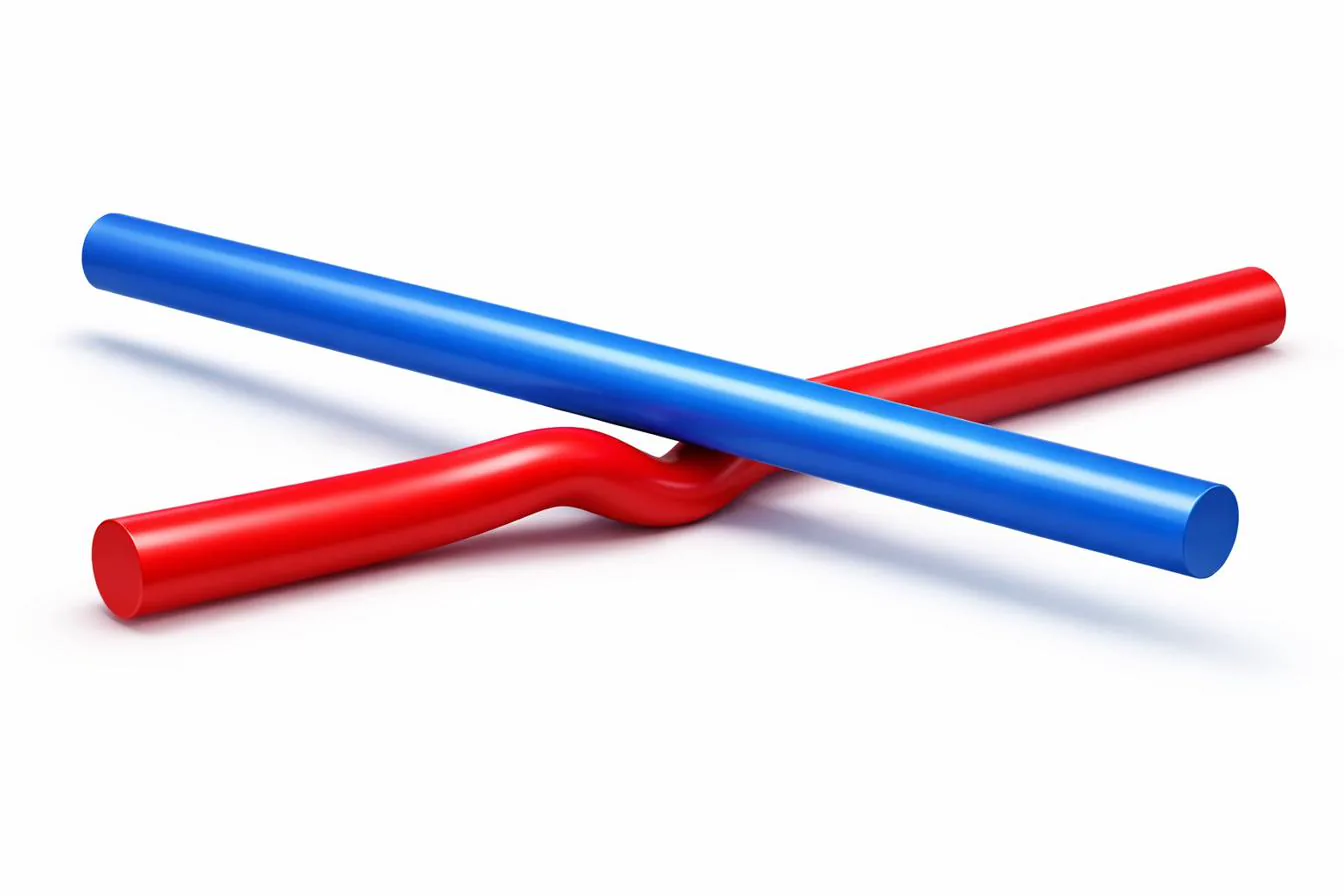
Underground, the third dimension is almost free. Where the surface must choose between a red light, a bulky roundabout or a costly overpass, the tunnel simply dips a few metres. The crossing disappears.
2. Changing direction: the roundabout
That leaves the case where you want to leave your tunnel for another one. Here again, no stopping: you take the green ring. Short ramps connect each tunnel to a one-way circular tunnel. You enter it with a simple give-way, ride the ring to your exit, and join your new axis. No light, no stop, no four-way face-off.
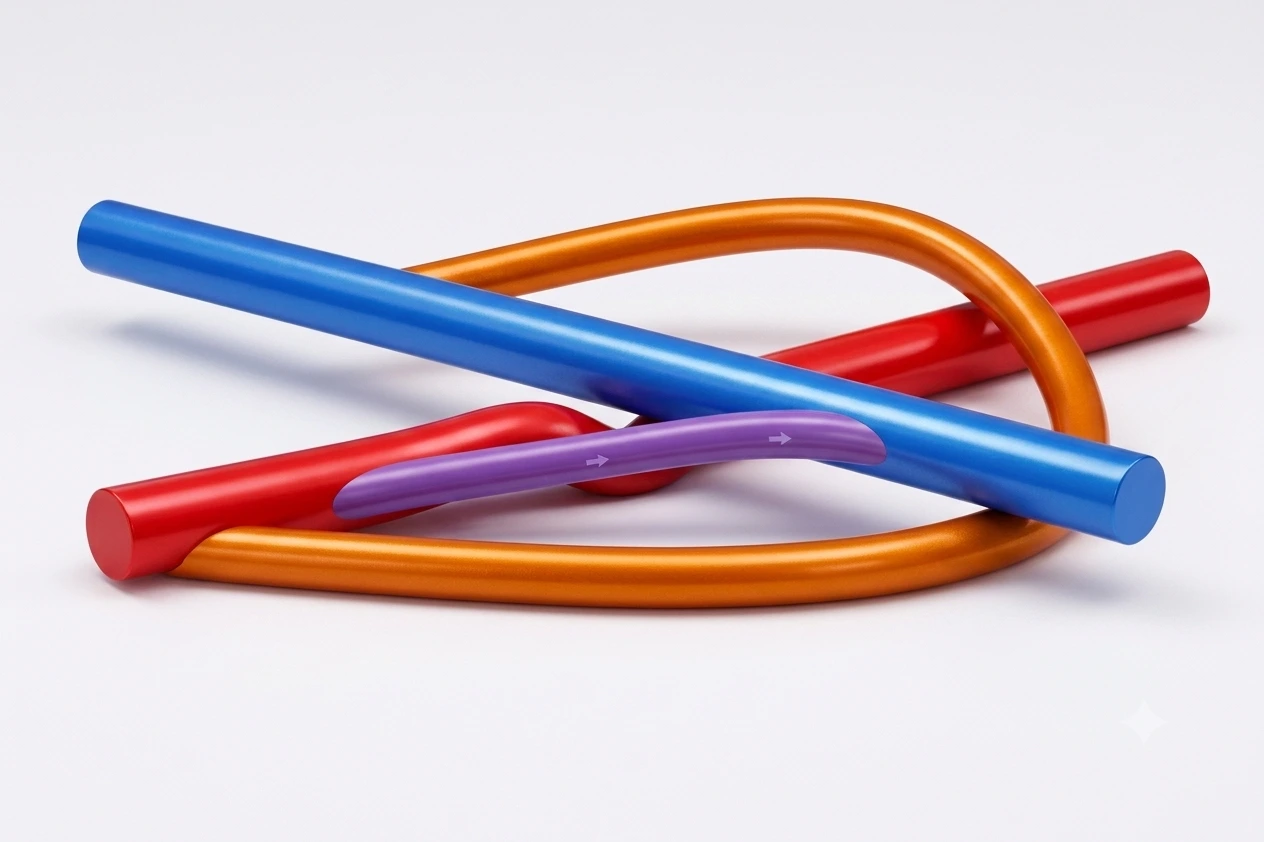
Priority always goes to those already in the ring. The arriving cyclist barely slows, slots into a gap and exits at the right branch. It's the cycling version of the road roundabout — a geometry proven the world over to keep traffic flowing. And because a bike is small and slow compared to a car, gaps are continuous and easy to catch: the ring can stay compact.
A crossing, step by step
- I approach the interchange on my tunnel.
- Going straight? I do nothing — I pass over or under the cross axis, without slowing down.
- Want to turn? I take the ramp onto the green ring and give way to cyclists already engaged.
- I slot into a gap, follow the ring, exit at my branch. I never put a foot down.
3. Why it's almost all upside
⚡ Speed preserved
No stops at crossings: average speed stays high across the whole network. That's exactly where surface paths lose the most time.
🛡️ Safer
No head-on collision, no right-angle crossing: every movement is a low-angle merge, in the same direction. It's the geometry that makes roundabouts safer than intersections.
🔀 No bottleneck
Capacity holds where the axes meet — exactly the weak point of conventional cycling networks, which saturate at intersections.
🔧 Simple and robust
No lights to power, synchronise and maintain, no sensors. Just geometry and a "give way" sign. Nothing that can break down.
🚴 The joy of momentum
The cyclist keeps their pace. That's exactly what makes cycling enjoyable — and what a dedicated underground network can deliver continuously.
📐 Compact
At bike speed, the ring stays small. An underground interchange fits in a far smaller footprint than a highway interchange.
4. What diameter to enter at 40 km/h?
The question comes up naturally: how big must the ring be for a cyclist travelling at 40 km/h to enter the roundabout without breaking their momentum?
On a curve, a bike leans; balance follows a simple law: tan θ = v² / (g · R). If you wanted to maintain 40 km/h in the ring, with a comfortable lean of 15 to 20° and a superelevation of 6 to 8 %, you would need a radius of 35 to 47 m — that is, a ring 70 to 95 m in diameter. That's excessive: 220 to 300 m of circular tunnel, and paradoxically less safe, because merging into a flow at 40 km/h demands large gaps and a line of sight that the inner wall of a curved tube cannot provide.
The right engineering answer lies elsewhere: you size the ring for ~30 km/h, and shed the difference for free through geometry. Going from 40 to 30 km/h corresponds exactly to a climb of 2.8 m (Δh = (v₁² − v₂²) / 2g). So you simply perch the ring about 3 m above the main tubes: the entry ramp climbs, the cyclist naturally arrives at the ring's speed without touching the brakes; they give way, turn, then the exit ramp drops back down and returns all their speed. Net energy cost of the detour: just about nil.
The third dimension again. The same principle that makes crossings disappear serves here as a free brake: 3 m of climb converts the excess speed into altitude, and the exit descent restores it all. The ring doesn't need to be large — it needs to be well placed.
| Speed in the ring | Axis radius (8 % superelevation) | Diameter | Verdict |
|---|---|---|---|
| 25 km/h | 14 – 18 m | 28 – 36 m | Compact, but light braking required |
| 30 km/h | 20 – 25 m | 40 – 50 m | Recommended: smooth entry from 40 km/h |
| 40 km/h maintained | 35 – 47 m | 70 – 95 m | Excessive, difficult merge |
The sweet spot is around 45 to 50 m of axis diameter. At Ø 40 m, the lean nears 15° — sporty; at Ø 50 m, it drops to ~11°, comfortable for everyone. And it's actually sight distance, more than the superelevation, that decides: at 30 km/h you need to see 20 to 22 m ahead along the inner wall in order to stop — which a radius of 22 to 25 m provides, as long as the ring's cross-section is widened slightly.
Can Prufrock build this?
Partly. The ramps, yes: gradient transitions are the machine's specialty — it launches into the ground at an incline from a truck and emerges at the other end by "porpoising," with no pit or crane. A ramp that climbs 3 m at 5 – 8 % is exactly in its wheelhouse. The ring, no: when The Boring Company wanted to demonstrate Prufrock's maneuverability, it showcased a 190 m radius curve at the exit of the Resorts World tunnel in Las Vegas. Our ring, at 20 – 25 m radius, is 8 to 10 times tighter — no tunnel-boring machine of that size follows such a curve. And cutting a junction into the wall of an existing tube is never a boring-machine job anyway, at TBC as elsewhere.
The node is therefore built by conventional methods, chosen to suit the site: the mined approach (roadheader or drill-and-blast — Québec's bedrock lends itself to it), with a custom section about 4.3 to 4.5 m wide for the two lanes of 1.6 to 1.75 m (inner lane for those circulating, outer lane for merging in and out); or cut-and-cover — at 10 – 13 m depth, you excavate a 50 to 60 m pit from the surface, pour the ring in concrete, and backfill. Where a parking lot or a park is available overhead, it's often the cheapest solution — and it's the technique TBC already uses for its own stations.
The division of labour — already in the budget. The boring machine does the kilometres; the nodes are conventional works. It's the model of TBC itself in Las Vegas, where the lines are bored and the stations built separately. That's exactly why the "mined junctions" line is the expensive item in the costing below, and why the ring is priced there at the conventional rate ($25–60M/km) rather than the Prufrock rate ($12M/km). An honest caveat: the Vegas Loop has never yet built a grade-separated underground interchange of this type — it's a natural extension of proven techniques, not an already-demonstrated achievement.
5. What a complete roundabout costs — and how we compute it
The costing follows the same method as the construction costs file, in four transparent steps:
- Start from the file's unit costs: ≈ $12M/km of tunnel bored by the boring machine in Québec bedrock.
- Mark up the short mined sections: a 140 m ring enjoys no economies of scale (mobilization, custom section, tight curvature) — count 2.5 to 5 times the per-kilometre rate, i.e. ≈ $30–60M/km.
- Measure the quantities from the geometry: circumference π × 45 m ≈ 140 m of ring; 8 ramps of 50 to 70 m (≈ 400 to 550 m total); 12 junctions (4 on the main tubes, 8 on the ring).
- Reuse the file's lump-sum items (mined junctions, systems at the node), sum, round into a range.
| Item | Basis of calculation | Order of magnitude |
|---|---|---|
| Ø 45 m two-lane ring (≈ 140 m mined, widened section) | ≈ $30–60M/km | $5–9M |
| 8 ramps (4 entries + 4 exits, ≈ 400 – 550 m) | ≈ $15–25M/km, small curved profile | $6–12M |
| 12 mined junctions (4 on the main tubes — the expensive ones — and 8 on the ring) | $3–5M and $1–2M each | $20–30M |
| Systems at the node (ventilation, lighting, signage, drainage) | file line item | $6–10M |
| Total — complete two-lane roundabout | ≈ $40–60M (centre ~$50M) |
This total lands at the top of the file's range ($25–60M per interchange) — logically, since the two-lane roundabout is its complete version. The costs file adopts precisely this cautious assumption: budgeting the complete roundabout (≈ $50M) for each of the ≈ 29 nodes, i.e. an envelope of ≈ $1.45B. Minor nodes, with simple direct ramps, would cost less; keeping the complete version everywhere keeps the budget on the safe side.
Two figures for one and the same interchange — why $50M and not $70M? The ≈ $50M above is a direct construction cost: the concrete, the boring and the systems of the node itself. Like every hard cost in the project, this amount is then marked up, in the overall budget, for engineering and design (10%), project management (5%) and technical contingency (20%). Stacked, these three rates multiply every hard dollar by 1.15 × 1.20 ≈ 1.38: an interchange of $50M in works therefore weighs ≈ $65 to 70M "all-in" in the total. The two numbers describe the same structure — one before the budget cascade, the other after.
An important point: this markup is already included in the ≈ $12.7B total of the file. It must therefore not be added a second time. The $1.45B envelope (29 × $50M) is a hard subtotal; once propagated through engineering, management and contingency, the interchanges' share of the final budget approaches $2.0B — a figure that already appears within the $12.7B.
The perspective that reassures. A single highway interchange like Turcot, in Montréal, cost ≈ $3.7B. At ~$50M, a complete cycling roundabout — two lanes, cut into bedrock — comes out about 70 times cheaper.
Where two axes meet
| Situation | Surface intersection | Underground interchange |
|---|---|---|
| Going straight | Red light or stop — frequent stopping | Passing to another level — no stopping |
| Turning | Waiting, turning across the opposing flow | One-way ring — give-way, no stopping |
| Conflict points | Right-angle crossings, possible head-on collisions | Only low-angle merges |
| Equipment | Lights, sensors, maintenance, electricity | Geometry + a "give way" sign |
| Average speed | Broken at every intersection | Continuous, preserved |
A network where you (almost) never stop.
The two-level crossing settles "straight through"; the roundabout settles "turning." Together they remove what slows the bike down in the city — the stops — while making crossings safer. That is the whole point of a dedicated underground network: giving the cyclist back their momentum.
Schematic diagrams and preliminary figures, meant to illustrate the operation and the order of magnitude; the exact geometries (ring radius, ramp gradients, level changes, excavation method) and the detailed costing are a matter for detailed engineering.
Main sources. The Boring Company — Prufrock page (inclined launch from the surface, recovery with no pit or crane); The Boring Company on X, January 2022 — 190 m radius curve presented as a maneuverability demonstration at the exit of the Resorts World tunnel (Vegas Loop).