A natural 10 °C thermostat, at marginal cost
The tunnel is the borehole. Adding geothermal loops while we dig costs a fraction of a stand-alone installation. The result: heating in winter, cooling in summer, and a single piece of infrastructure that does double duty.
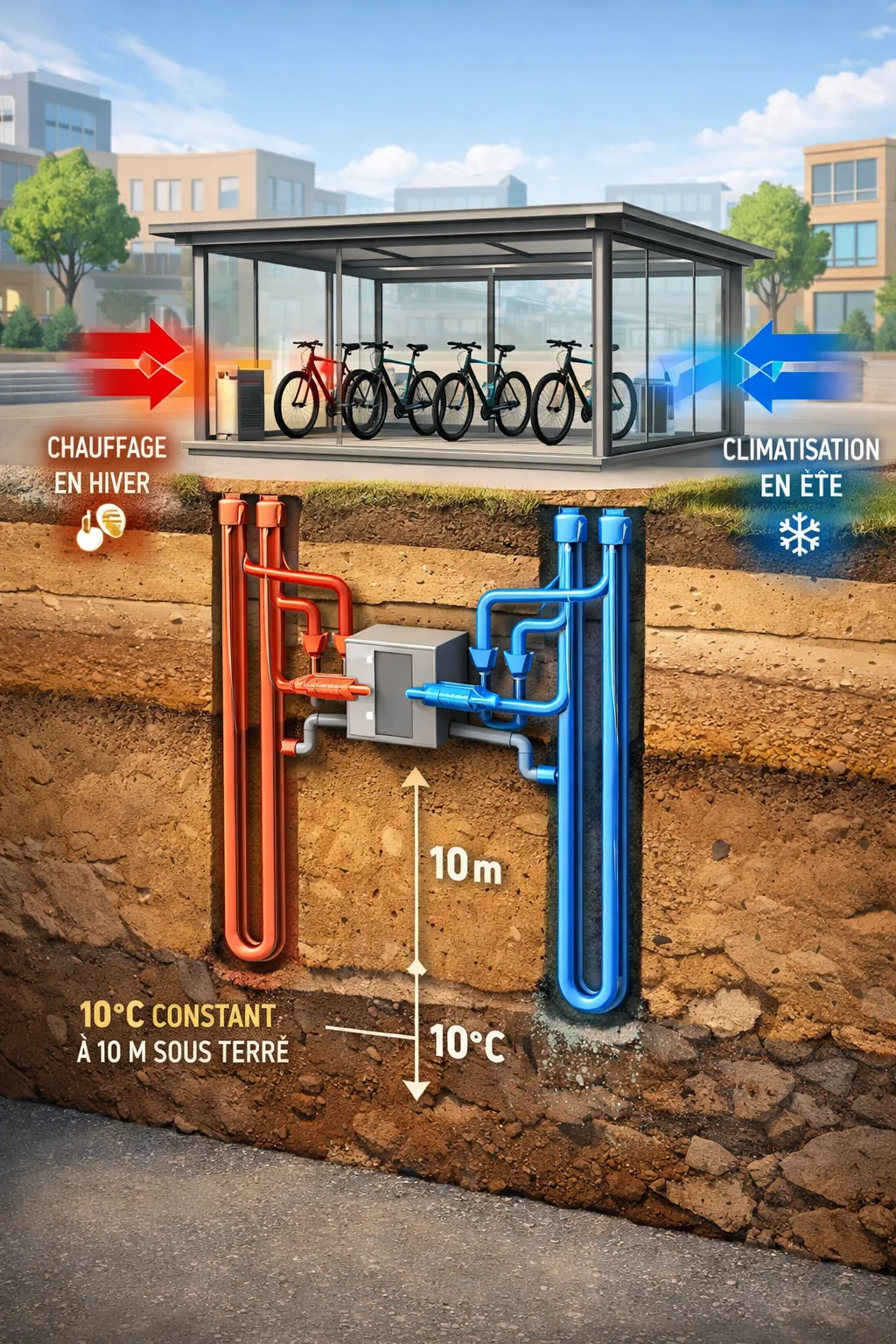
Why it works: the bedrock doesn't « feel » winter
At the surface, the temperature swings enormously — from over 30 °C in summer to below −25 °C in winter in Québec City. But that oscillation damps out very quickly with depth: the ground acts like a giant thermal flywheel. At around ten metres, almost nothing is left of the surface's seasonal variation.
Stable all year long, summer and winter alike. It's the same figure as the depth of our stations.
The gap between January and July at this depth is minimal — practically constant.
Over 55 °C of annual range. That's what we avoid by going deep for the heat.
Our stations already descend to this depth — geothermal energy is within arm's reach.
Two free sources, already beneath our feet
The station actually enjoys a double thermal advantage unique to our network, which no ordinary building at the surface has:
1. The tunnel's mild air
The tunnel air stays around 10 °C thanks to the bedrock, and it rises naturally toward the entrances. A station backing onto the tunnel therefore does not start from the freezing air of the street: it already starts at 10 °C. That's heat already paid for by the ventilation — we just have to recover it.
2. The bedrock's geothermal energy
Loops buried next to the station exchange with the bedrock at 10 °C: we draw heat in winter and reject heat in summer. The same hole serves both ways, as the seasons turn.
The honest caveat. Ground at 10 °C is mild, not hot. To bring a station up to 20 °C, you need a heat pump — and a heat pump consumes electricity. Geothermal energy therefore doesn't eliminate the bill: it divides it by 3 or 4. For every 1 kWh of electricity put in, the heat pump delivers 3 to 4 kWh of heat (that's its « COP »). It's excellent, but it isn't zero — and saying so clearly makes the argument solid in front of an engineer.
The math, for a typical station
An entrance station is a demanding environment to heat: a glazed pavilion, doors opening constantly, a permanent draft (the tunnel's chimney effect). Let's assume such a station needs the equivalent of 100 kW of peak heating in deep cold, and compare three ways of heating it:
| Heating method | Electricity consumed | Verdict |
|---|---|---|
| Electric baseboards (direct heating) | 100 kW | Simple, but expensive. The benchmark to beat. |
| Geothermal heat pump (COP 3.5) | ≈ 29 kW | ≈ 70 % less electricity for the same heat. |
| No heating | 0 kW | Station a few degrees above zero, slippery floors. Unacceptable for a public entrance. |
In summer, the same system cools for free. During a heat wave, the bedrock at 10 °C becomes a well of coolness: the heat pump reverses its cycle and cools the station by rejecting heat into the ground. A single investment, two uses — heating in winter, cooling in summer. It's the strongest advantage of the approach.
What it changes on the network's bill
Heating and cooling the entrances are already counted in the energy line of the operating budget ($9.5 M/yr), within the « stations » share. Today that figure assumes direct electric heating. By switching to geothermal energy, we isolate this expense and reduce it sharply:
| Item (heating + cooling of the 150 stations) | Direct electric | With geothermal |
|---|---|---|
| Estimated annual energy | 10 to 14 GWh | 3 to 4 GWh |
| Annual cost (≈ 8.5 ¢/kWh, Hydro-Québec) | ≈ $0.9 to 1.2 M | ≈ $0.3 M |
| Annual savings | — | ≈ $0.7 to 0.9 M/yr |
In absolute terms, the savings remain modest against a ~$194 M/yr budget — electricity is already cheap in Québec. The real gain lies elsewhere: geothermal energy closes a question every reviewer will ask (« how do you heat 150 entrances in a Québec winter? ») and turns a blind spot into an argument — a transport network that also becomes a frugal energy infrastructure.
One infrastructure, two functions
Because we are already digging 150 km of tunnels and 150 stations 10 m deep, geothermal energy comes almost for free. It heats in winter, cools in summer, cuts the electricity of the entrances by 65 to 75 %, and reinforces the project's energy-independence argument — built on hydroelectricity and, now, on the heat of Québec's bedrock.
Key takeaways
- The bedrock at 10 m is at ≈ 10 °C all year long — a natural thermostat indifferent to winter as well as heat waves.
- Marginal cost: the tunnel is already the borehole, so the geothermal loops cost a fraction of a stand-alone installation.
- A heat pump is still needed: geothermal energy divides the heating electricity by 3 to 4, it doesn't eliminate it.
- Dual use: heating in winter, cooling in summer, with the same system.
- Savings: on the order of $0.7 to 0.9 M/yr, and above all an argument that strengthens the case.