A small, narrow electric shuttle with no driver on board.
A reassuring pace for passengers, close to that of bikes.
In each direction, for the shuttle, bikes and stops.
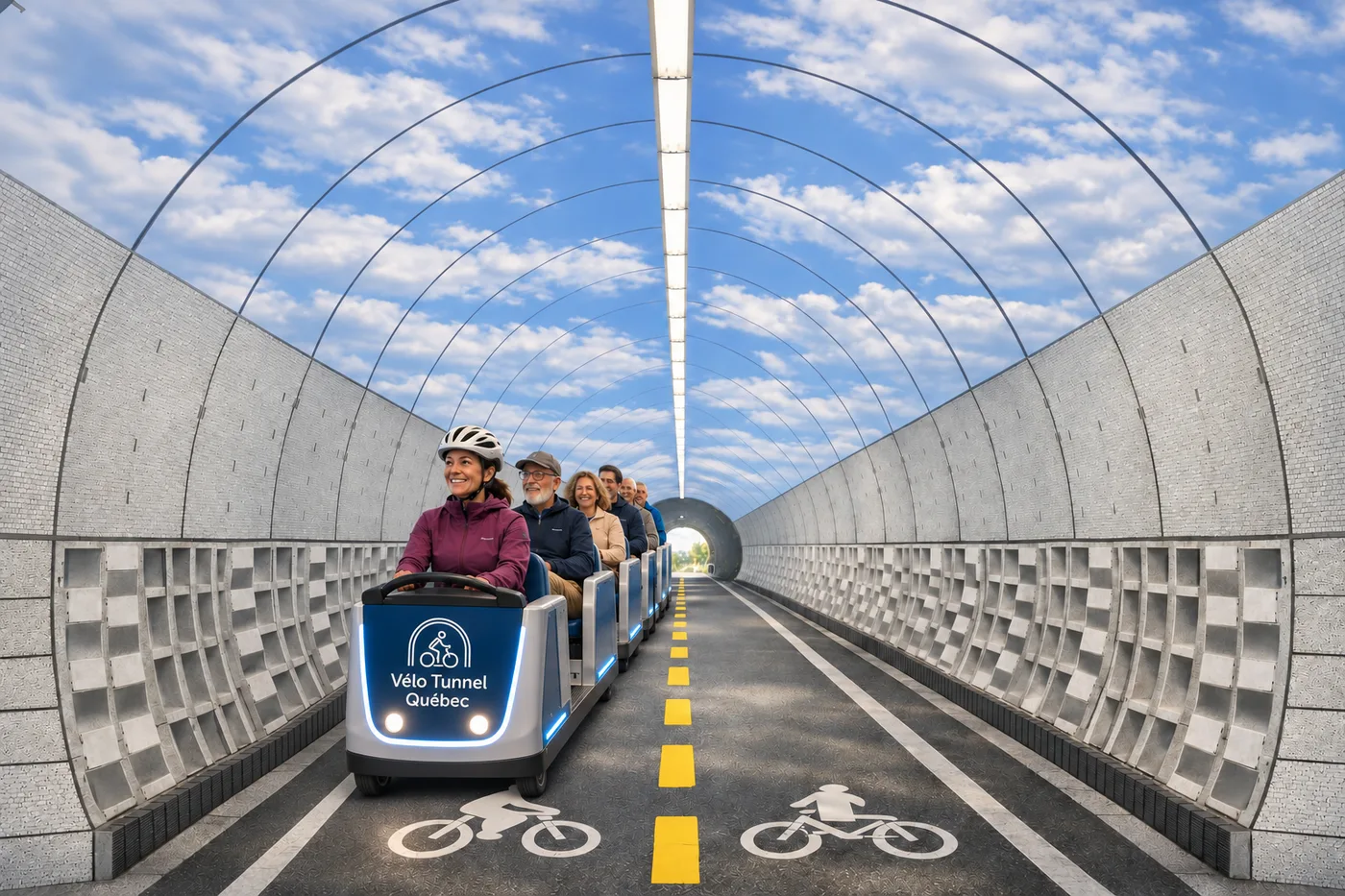
A mission, not a commercial service
A mobility network shouldn't serve only fit cyclists. An older person, a child too young for a long ride, a wheelchair user or a parent with a stroller should also be able to enjoy the tunnel.
The shuttle is therefore part of the network's mission. The bike remains at the heart of the project: the shuttle simply guarantees that no one is left behind.
How the shuttle works
The shuttle runs with no driver on board. The tunnel is well suited to it: a fixed route, a smooth roadway, no snow, no traffic lights and constant camera monitoring.
Autonomous driving
- Preprogrammed route with fixed landmarks in the tunnel, without relying on GPS
- Cameras, LiDAR and proximity sensors
- Automatic braking as soon as an obstacle is detected, without waiting for human intervention
Supervision
- A control centre watches all shuttles by camera
- It can remotely help a stopped shuttle get back on its way
- An intercom links each shuttle to the control centre
Accessibility
- Low floor and wheelchair access
- Doors or side guards, child-adapted seat belts
- Room for a child's bike or a stroller
Other roles
- Carrying an injured cyclist or a broken bike
- Support for the network's maintenance crews
- Sheltered travel for everyone, even in the middle of a storm
A passenger's trip
-
Arriving at a surface station
Passengers board only at stations, never in the middle of a tunnel. Elevators connect the surface to the platform, because a long 5 to 6% ramp is hard for an older person or a wheelchair user.
-
Boarding
The shuttle stops in a protected boarding zone, separate from the bike path. The passenger sits down and fastens their seat belt.
-
The ride
The shuttle runs in its lane at 15 to 20 km/h. If faster cyclists are behind it, it pulls into the next passing bay to let them by, then sets off again once the lane is clear.
-
Arrival
The passenger gets off at the station of their choice and returns to the surface by elevator.
Passing bays every 500 metres
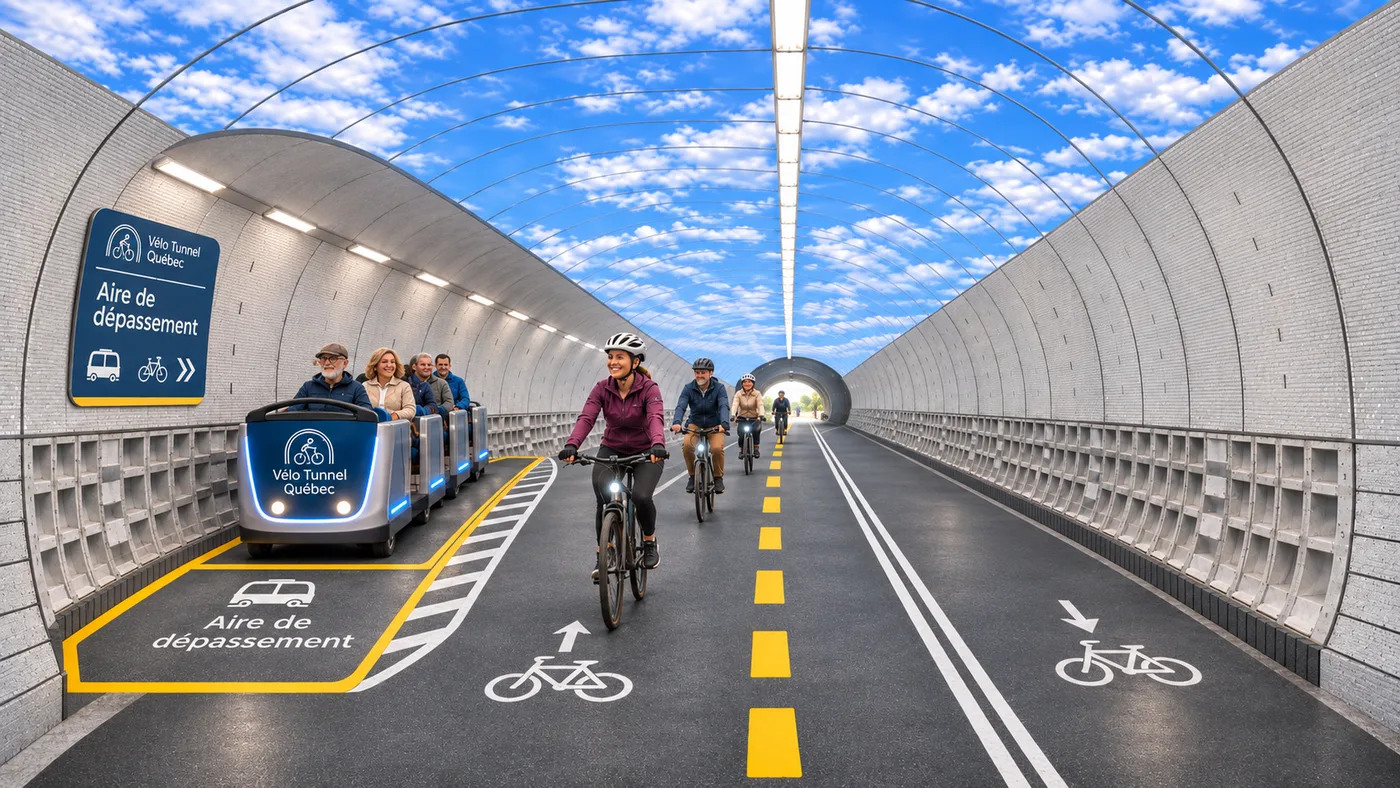
The tunnel path is 3.20 m wide, or 1.60 m per direction. That's enough to ride, but too narrow to overtake safely without encroaching on the opposite lane.
On an inclusive network, though, speeds vary widely. A child or a senior rides at 10 or 12 km/h, the shuttle at about 20 km/h and an experienced cyclist at 25 km/h. The overtaking problem therefore exists with or without a shuttle.
The solution: a widening of the path roughly every 500 m, in each direction.
Three uses for each bay
The shuttle pulls over, lets the bikes behind it go by, then resumes its route.
The slower cyclist keeps right and carries straight on. A child has nothing complicated to do.
Flat tire, fatigue or feeling unwell: stop safely without blocking the path.
| Passing bay | Preliminary value | Why |
|---|---|---|
| Spacing | ≈ 500 m per direction | Less than 2 minutes of travel between two bays |
| Length | 40 to 60 m | Overtake while riding, entry and exit included |
| Lateral widening | 1.2 to 1.5 m | Room for the shuttle or a stopped cyclist |
| Zone reserved for the shuttle | 15 to 25 m | Avoid conflicts with overtaking bikes |
Exploratory dimensions, to be validated by an engineering study depending on the chosen vehicle.
One simple rule: overtake only in the designated bays. Lighted signage linked to the cameras can warn a slow cyclist that a faster bike is coming up behind them and that a bay is approaching.
Fair pricing
The shuttle is free for those who need help most, and paid for other adults.
| User | Shuttle fare |
|---|---|
| Children under 12 | Free |
| Seniors aged 65 and over | Free |
| People with disabilities and their companion | Free |
| Teenagers | Reduced fare |
| Adults and tourists | Regular fare |
A family fare would let a parent accompanying a young child travel for free or at a reduced price. Since stations are automated, eligible users would use a personalized card and others would pay contactless, ideally with a single subscription that also covers public transit.
Planned from the first kilometre
Once the tunnels are dug, their diameter can no longer change. Lane width, curve radii, stations, elevators and passing bays must therefore be designed from the outset to accommodate the shuttle. Adding it afterwards would be impossible.
The images on this page are conceptual illustrations. The real tunnel is tighter: 3.66 m inside diameter and 2.30 m of clear height at the centre. See the tunnel dimensions.