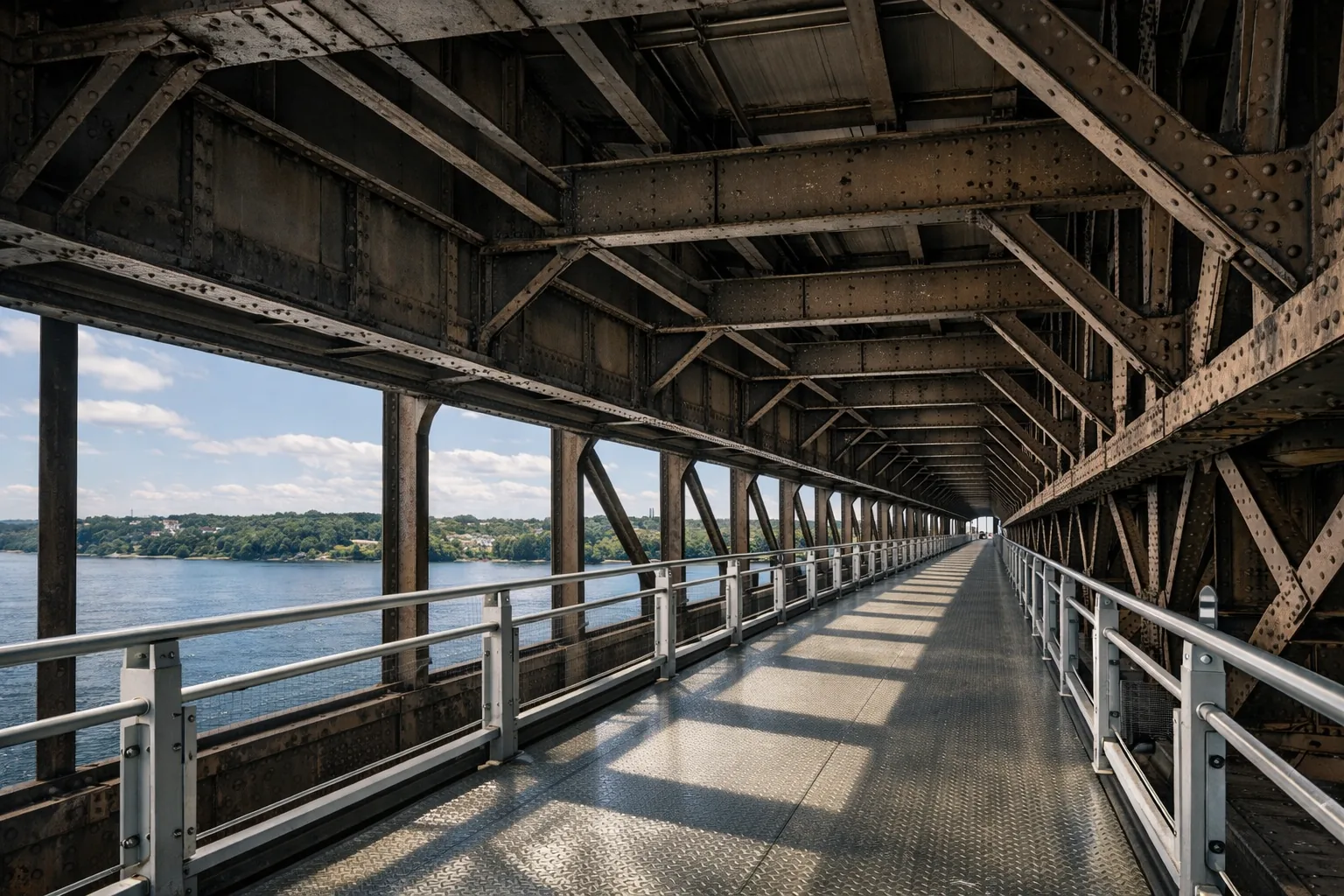
The Québec Bridge already has a bike crossing, but it is a narrow 1.32 m sidewalk shared between pedestrians and bikes going both ways — so cramped that cyclists are normally expected to get off their bikes to cross it. Its deck is at the end of its useful life and has to be rebuilt over its entire length anyway. This is the chance, one that comes around only every 75 years, to replace that sidewalk with a real walkway.
Remove the old sidewalk, tuck the new one under the slab
The idea comes down to two moves. First, we remove the narrow sidewalk that exists today, which frees up weight and space on a century-old bridge that has almost no load reserve left. Then we install a 2.3 to 2.5 m wide walkway, for bikes and pedestrians — but we do not hang it as a cantilever off the side of the bridge. We tuck it under the road slab, inside the steel framework that is already there.
That choice is what changes everything on the weight side. Rather than suspending a heavy new structure that would span the river on its own, the walkway rests on the bridge's existing frame, which carries it. We replace, we do not merely add — and we reuse the steel already in place. The extra load stays modest, well within reach of a rebuilt deck.
Bikes and pedestrians, versus 1.32 m shared today.
The road above acts as shelter — no glazing, no heating.
The time it takes to ride from one shore to the other, under cover.
Under the road, so sheltered from rain and snow
The main nuisance of a bike crossing is not the cold — it is the rain and snow. By tucking the walkway under the deck, we solve that nuisance almost for free: the solid road slab becomes a roof right overhead. Precipitation falling vertically is blocked by the bridge itself. No glass tube needed, no heating needed — the shelter comes with the structure.
The cold? A few minutes, not a deterrent
The crossing lasts only about 3 to 4 minutes. On a bike you generate your own heat by pedalling, and you are already protected from precipitation by the slab above. So all that is left is a few minutes of fresh air to get through — far too little to justify the weight and cost of a closed, heated tube. Québec's winter cyclists already ride through far worse every day. The cold of a short crossing is not an obstacle.
We work with what we have. This is not a climate-controlled, perfect crossing — it is a lean, light, low-cost solution that builds on the existing bridge and on its already-necessary reconstruction. We are not after the comfort of a heated tunnel on the bridge: we are after a safe, sheltered passage that does not overload a century-old structure.
Complementing the shuttles, not competing with them
The walkway and the shuttles are not fighting over the same cyclists: they relieve one another. Whoever is in a hurry and self-sufficient rides the walkway themselves, with no wait and no loading their bike. Whoever would rather be carried — in bad weather, with a child or a load — takes the shuttle. Together, the link is more flexible and more robust: if one is interrupted, the other holds the crossing.
The walkway also acts as a relief valve at the network's one real bottleneck. Every cyclist who chooses to ride themselves is one fewer bike to load — which keeps the shuttle cadence reasonable Interchanges, rather than pushing it to the extreme at peak.
Not a heated tube. A simple walkway, under the bridge.
We remove the narrow sidewalk that exists today and replace it with a 2.3 to 2.5 m walkway tucked under the road slab. The bridge makes the roof — sheltered from rain and snow, with no glass and no heating. And for the 3 to 4 minutes of the crossing, the cold is not a deterrent: you pedal, you are covered, you work with what you have. A light, robust piece of the Québec–Lévis link, while we wait for the under-river tunnel.
An honest caveat: this facility depends on the reconstruction of the Québec Bridge deck, which does not yet have a firm schedule. Its feasibility must also be confirmed by the structural analysis of the Ministry of Transport. That is precisely why this idea has to be carried forward now, while the design of the new deck is still open.