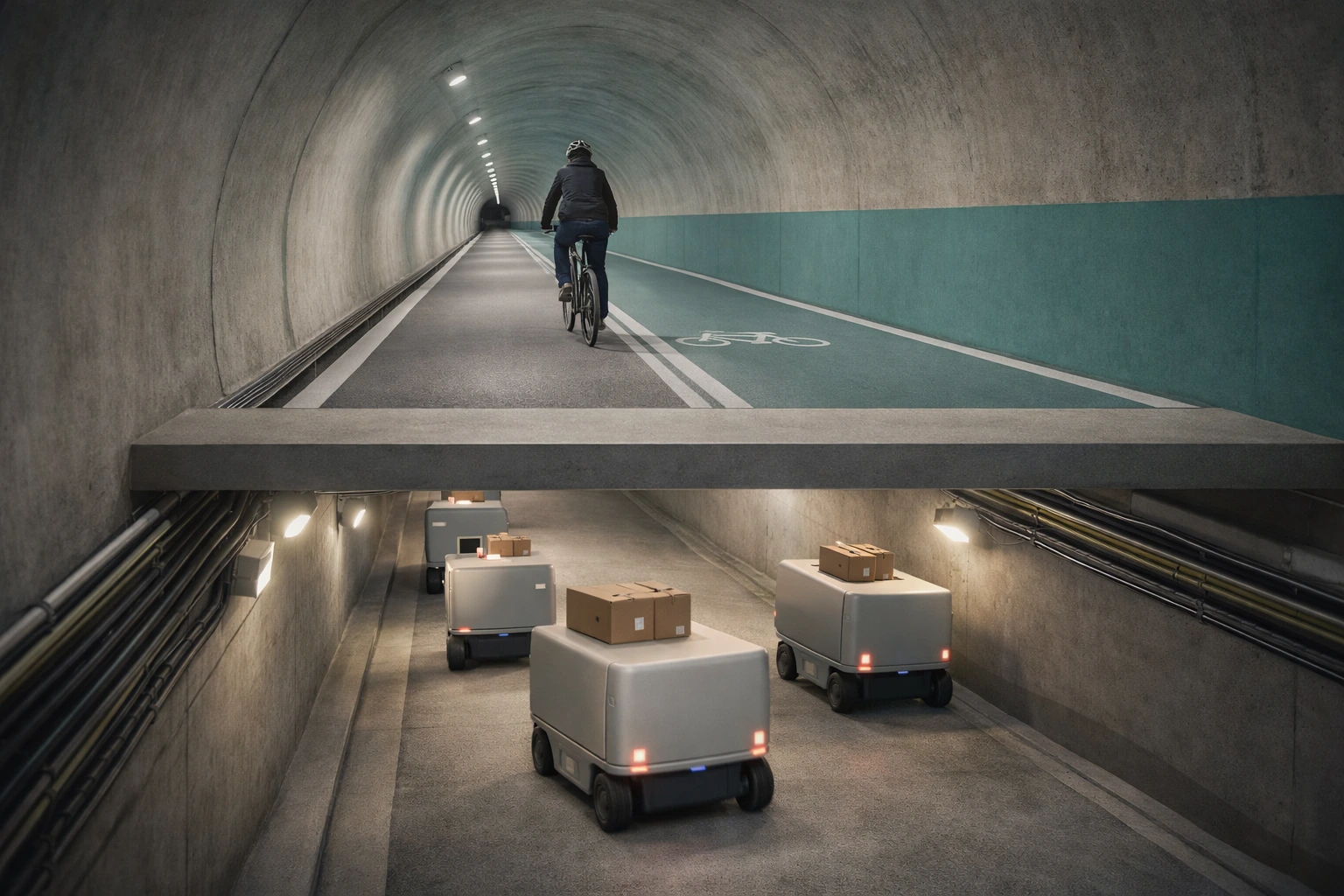
The hole is dug only once. It can deliver too.
Beneath the bike path, the space set aside for drainage and cables can host a lane of small delivery robots. One more service — green and cheap — and a new revenue stream, with almost no extra digging.
The principle: a lane beneath the path
Below the deck where the bikes roll, the tunnel already keeps a technical space for drainage and cables. By adding a running slab, part of that space becomes a low gallery where small autonomous robots travel — entirely separated from cyclists, who neither see nor hear them.
Three levels, a single tube
- At the top: the bike path, 2.40 m of clear height — unchanged.
- In the centre of the gallery: the lane of rolling drones (~0.75 m).
- On the sides: passive networks such as fibre optics — and, where applicable, electricity in a sealed, fire-rated, separate enclosure.
- At the bottom: drainage and cables, whose access stays preserved.
The gallery therefore shares the space with the networks the tunnel already hosts (see Other uses). High voltage, which gives off heat, always stays isolated in its own enclosure — never out in the open beside the robots.
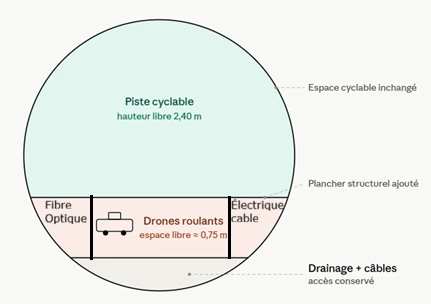
Enough to house small cargo robots, beneath the path.
All-weather, sheltered from snow and freezing rain.
The path's 2.40 m do not move by a single centimetre.
The tunnel is already dug for the bikes.
Why rolling drones, and not flying ones
The word « drone » often conjures up a flying machine. Underground, in a confined tube, that is exactly what to avoid. The right choice is the robot that rolls.
✓ The rolling robot
- Rolls on the ground and stops dead if something goes wrong
- Low energy, low fire load
- No blast, no turbulence near users
- Silent — compatible with the tunnel's acoustic care
To avoid underground: the flying drone
- Requires a height the tunnel need not provide
- Its downwash is dangerous near cyclists
- Noisy in an already reverberant space
- Lithium batteries in flight: the worst fire load, in the worst place
A useful service on three counts
Green
The robots are electric: no combustion, no exhaust, and recharging possible from Québec hydroelectricity. Above all, every parcel that travels underground is one fewer van at the surface — less traffic, less noise and fewer emissions in the streets.
Cheap
The « last mile » is the most expensive part of any delivery. Automating it in a tunnel — no driver, no traffic jam, no weather — sharply lowers the cost. And since the tunnel is already dug for the bikes, the cost of adding a lane stays low.
A revenue stream
Couriers, retailers, pharmacies and grocers can pay to access the network, just as the telecoms already pay to bury their fibre there. Every delivery contract becomes revenue that lightens the bill for cyclists — exactly the logic of the other uses of the tunnel.
The realistic model: from hub to locker
The robot handles the core of the trip, not the customer's doorstep. The parcel travels fast and cheaply from one access point to another, then waits in a station locker, where the customer collects it — or a final surface relay delivers it. That is how real underground networks work: hub-to-hub transport, completed by surface distribution.
It already exists elsewhere
The idea is nothing like science fiction. In Switzerland, the Cargo sous terrain project is building an underground freight network — a first stretch of about 70 km toward Zurich, financed entirely by the private sector. In the United States, the startup Pipedream Labs is already deploying delivery robots in underground tubes at the scale of the small parcel, closer to our gallery.
Reference points: Cargo sous terrain (Switzerland) and Pipedream Labs (United States) — real projects in development. Orders of magnitude cited for indication only.
A supplementary revenue, not the project's justification. Underground delivery will not pay for the tunnel on its own — the heart of the project remains the cycling network. But because the tunnel is already dug, the cost of adding it is low and the service is a genuine asset: clean, cheap, available all year round. One more use for a single piece of infrastructure.