First, let's put the distance in perspective
The route was not drawn along the major highways, but directly over the most densely populated neighbourhoods, so that the greatest number of people have both their origin and their destination near an entry station. The result: the last mile is almost never a real mile.
Residents a few minutes' walk from a station, or at worst a bus ride to an entrance.
People living less than a kilometre from a network route.
A broader catchment, fully relevant in the age of the e-bike.
The key point, often overlooked. The tunnel user is already a cyclist: someone ready to pedal 8 or 10 km underground can easily cover 500 m to 1.5 km on the surface. The real last-mile challenge is therefore not distance — it's the comfort of that short segment: weather and safety. That is exactly what the solutions below address.
A solution for every profile
There isn't a single answer, but an answer that depends on where you live. In plain terms:
| Distance to the station | The simplest solution |
|---|---|
| Very close — a few hundred metres | Walk to the station, then a shared bike for the whole underground trip. |
| 500 m to 1.5 km — the most common case | A feeder bike to the station (your own or a bikeshare), on plowed paths in winter. |
| Farther out — beyond the walking catchment | Bus or neighbourhood shuttle to the station, or a bike on a rear rack on the car, or park-and-bike at the entrance. |
The full range of options
None of these solutions needs to be universal: together, they cover just about every case. We combine them according to the neighbourhood, the season and each person's habits.
🚶 Walking + shared bike
- For residents very close by: walk to the entrance
- A shared bike or e-scooter waits at every station
- No bike to own, maintain or store
🚲 Your own bike, parked securely
- Every station offers secure spiral bike parking — about 150 spaces
- The winter trick: an old “neighbourhood” bike for the home-to-station segment, taking the salt and slush instead of your good one
- You can even leave a 2nd bike permanently at your arrival station
❄️ Four-season bikeshare, at both ends
- A network fleet equipped for winter (studded tires), available year-round
- A shared bike at the start and at the arrival solves the last mile without wearing out your own bike
- This is the Dutch OV-fiets model (shared bikes at stations), among the most effective feeder systems in the world
🚌 Bus + integrated fare
- A simple bus ride to the station, then a bikeshare
- Ideally, a single pass covers bus + tunnel + bike — three modes become one trip
- Bike racks on the buses that serve the stations, as already exist in summer
🚗 Bike on a car rack
- Drop your bike at the station by car, on a rear rack
- Handy for distant suburbanites or bad-weather days
- Combined with the park-and-bike below, it captures people beyond the 2 km catchment
🛗 Existing indoor networks
- Québec already has indoor pedestrian networks (Université Laval, major centres, hospitals)
- A station that opens directly into these networks removes the last segment for thousands of people
- The whole trip is then made under cover, from origin to destination
The neighbourhood shuttle
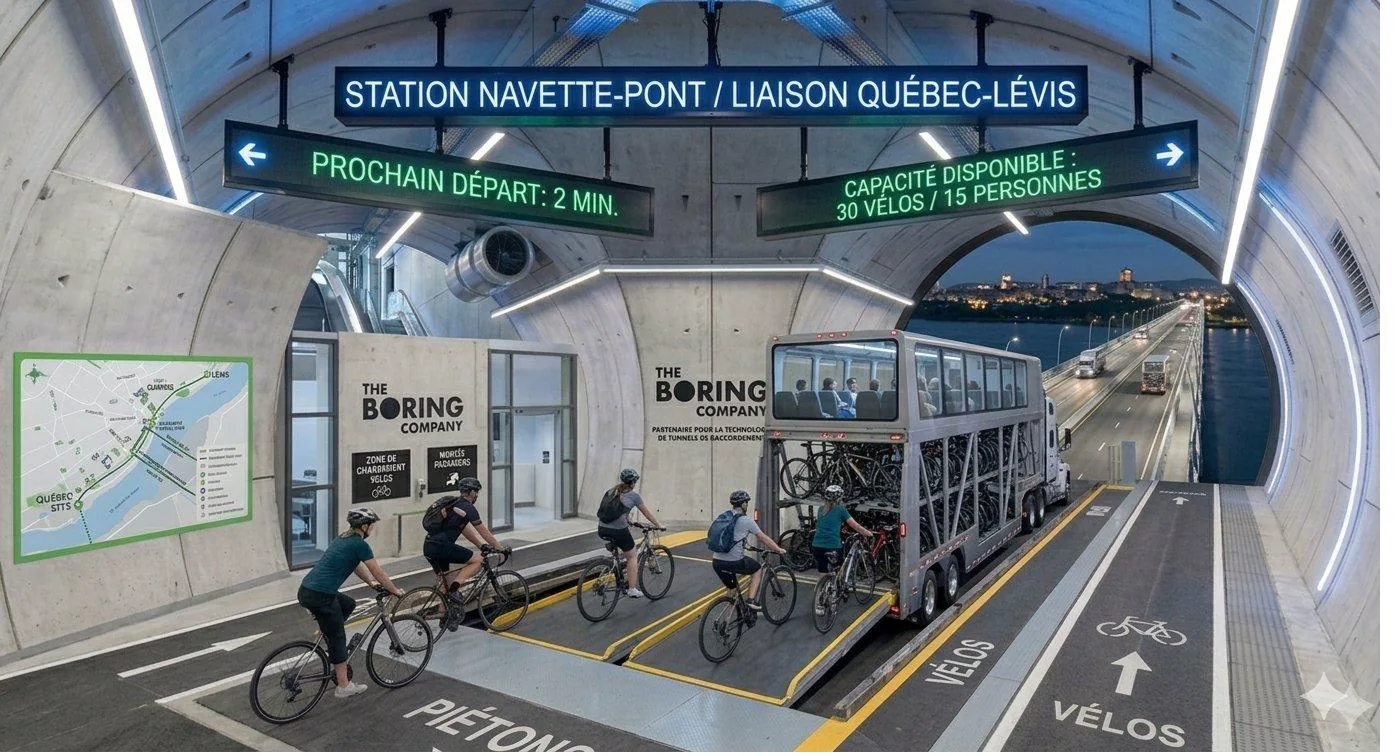
The idea is simple and remarkably effective: a small bus on a very short route that does just one thing — loop through a residential neighbourhood and drop people at the station. No long line, no detours: a local loop, frequent, dedicated to feeding the network.
Why it works
- Short loop, high frequency — the wait stays short, which is the key to any successful feeder service.
- Modest cost — small vehicles on a route of a few kilometres, without the infrastructure of a full line.
- A natural partnership with the RTC — the on-demand minibus service already exists in several areas; connecting it to the stations would cost next to nothing.
- Ideal in bad weather — on storm days, you wait in the warm rather than pedalling on the surface.
Park-and-bike
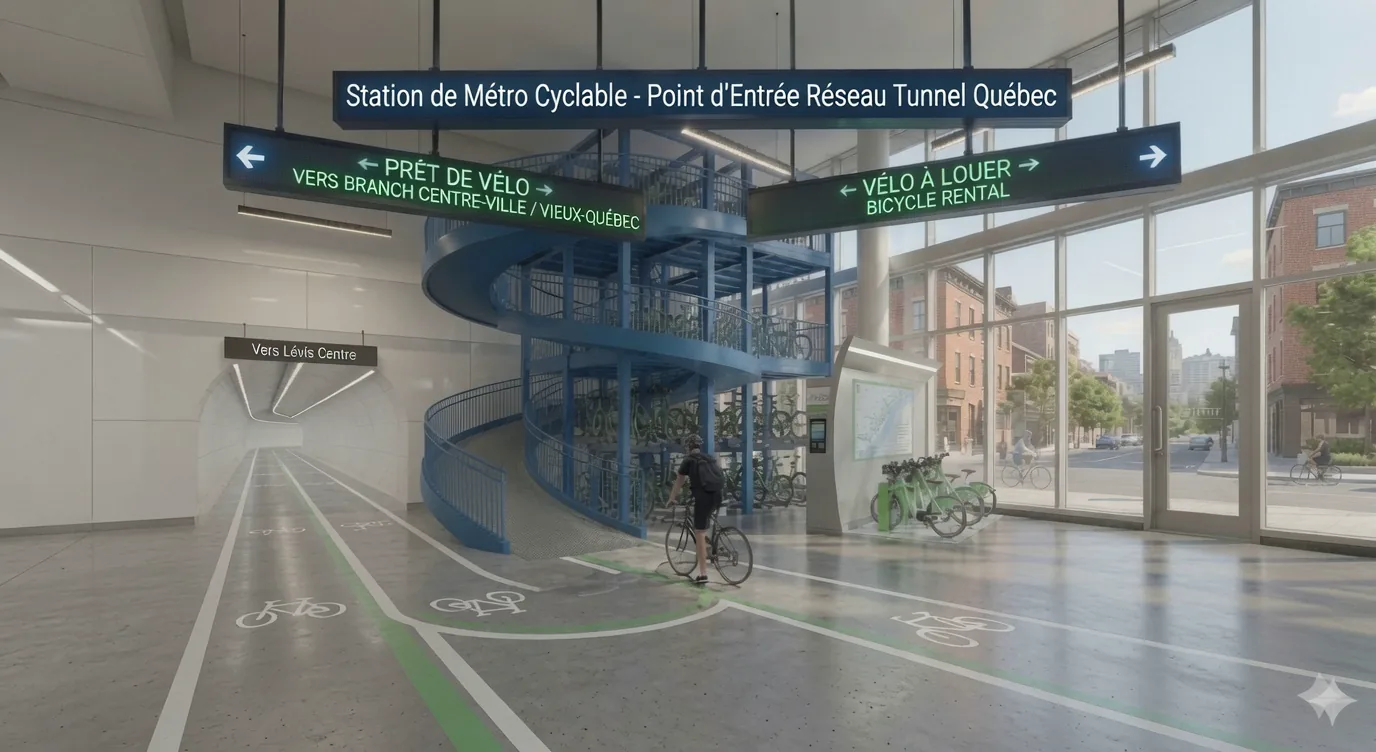
At edge stations — think Beauport, Charlesbourg or Cap-Rouge — you provide car parking near the entrance, plus a kiss-and-ride zone. You drive in from farther out, park, and switch to the network for the urban part of the trip.
It's the proven park-and-ride principle, applied to the bike: the car covers the countryside and the far suburbs, the tunnel swallows the urban congestion. The result, one fewer car on the saturated downtown arteries — exactly the project's goal on the motorist side.
Plowed feeder paths
Over 500 m to 1.5 km, cold and snow are perfectly bearable — provided the ground is cleared. The weak point isn't the temperature, it's an unplowed path. The answer requires no construction: an operating agreement.
Québec already maintains dozens of kilometres of four-season cycling paths. It's a matter of guaranteeing, around each station, a few priority feeder corridors integrated into that winter maintenance network. Nothing new is built: the stations are plugged into the existing plowing, and it is extended where a link is missing.
The takeaway: a tunnel sheltered from the climate 365 days a year loses its value if you shiver on an icy path to reach it. Treating the station surroundings as an extension of the network — and not as “someone else's job” — is one of the cheapest and most decisive levers of the project.
Comfort, four seasons
The cold discourages less through distance than through the discomfort of arriving soaked or frozen. A few simple amenities at the stations change everything — at a trivial cost on the scale of the project.
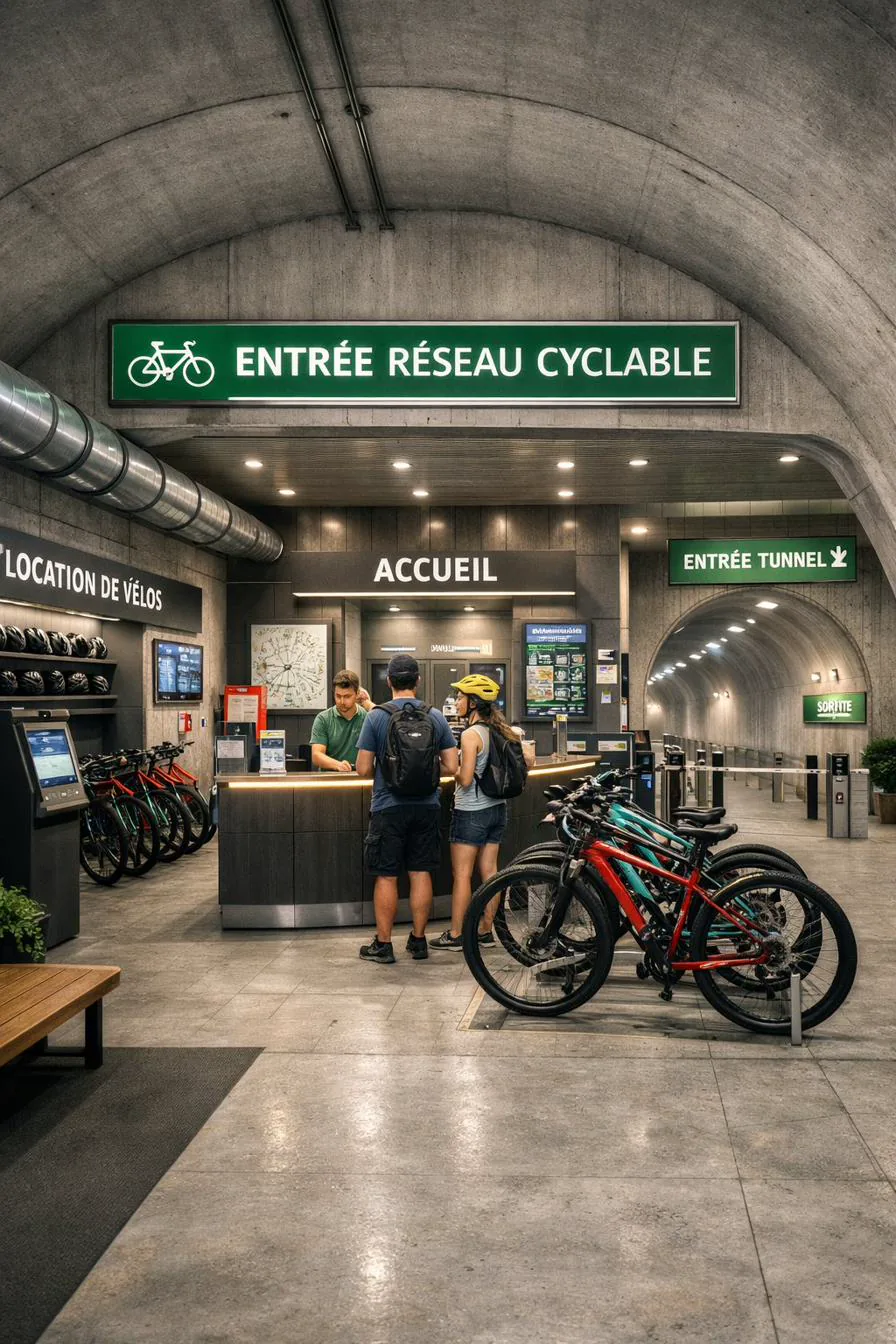
- Lockers to rent — to leave a raincoat, sweater or helmet at the station, rather than carrying everything around.
- Glove and boot dryers — as at ski resorts: negligible cost, huge effect on perceived comfort.
- Showers at major hubs (Sainte-Foy, Université Laval, Old Québec) — for heavy commuters, those who carry most of the ridership.
- Charging for personal e-bikes — the bike charges through the day, guaranteed full for the return.
Two underlying truths
Beyond the concrete solutions, two observations defuse the objection about duration.
The last mile is structurally simpler for a bike network: the user is already in the saddle. Getting off the subway means becoming a pedestrian again; leaving the tunnel means you keep riding.
Around 150 stations, housing and shops densify over 10 to 20 years — the effect seen around every subway station in the world. The critique describes day 1, not year 15.
Let's be honest. None of these solutions makes the network perfect for 100% of the population — and that isn't the goal. The aim was never to fit everyone into the tunnel, but about 10% of trips. The last mile therefore doesn't have to be solved for everyone: it has to be solved for those whose trip already “fits” within the network — and for them, the options above cover it amply.
Another idea for the last mile? This citizen project improves through hard questions. If you see a solution we've missed, write to us via the Contact page.