Every mode of transport has its Achilles' heel. The car costs a fortune. Buses, the metro and the streetcar break down, go on strike, impose a schedule. The surface bicycle is wonderful — six months a year. And all of them, without exception, keep us seated.
The idea behind Bike Tunnel Québec is not to invent yet another vehicle. It is to recombine two ideas as old as the world — the bicycle and the tunnel — to build a network that keeps the strengths of each mode and removes their flaws.
What if the solution weren't a new vehicle, but a new place to ride?
150 km of underground bike paths on the scale of the greater Québec City region. No red lights, no stops, no cars. Accessible 365 days a year, at any hour, whatever the weather. A world first, dug with the Prufrock tunnel-boring technology from The Boring Company.
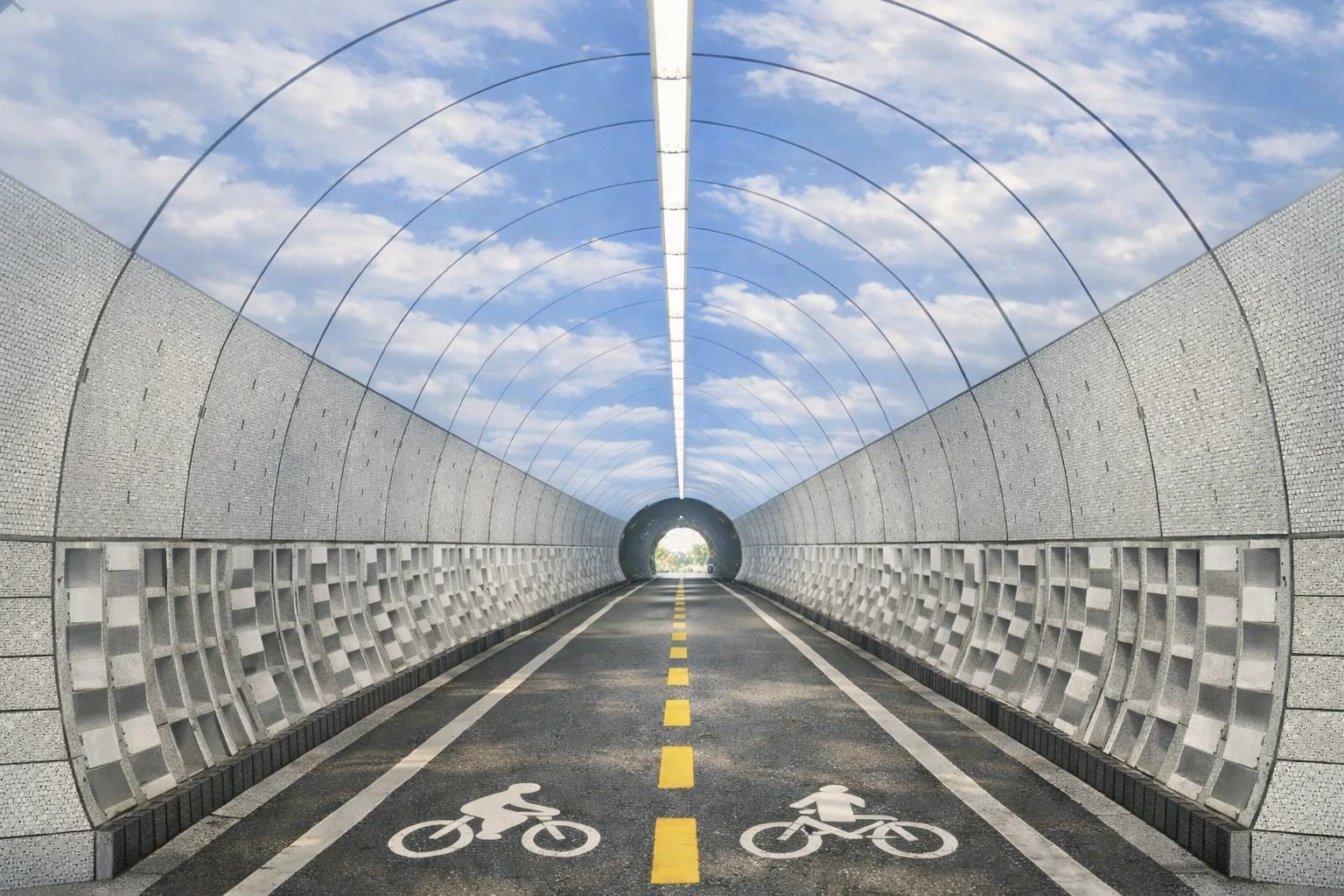
Every one of our transport modes has a major flaw
We argue endlessly about which mode to choose. We rarely argue about what's wrong with each one. Yet the picture is fairly simple: every option buys one quality at the price of a flaw.
Reliability
Breakdowns, strikes, imposed schedules. Buses, the metro and the streetcar depend on essential staff and complex equipment. When it stops, everything stops.
Cost
The car, for its part, solves reliability — but costs $8,000 to $12,000 a year, all in. And public transit lives on public subsidies.
Pollution
The private car remains one of the region's biggest GHG emitters, and the leading source of noise in our streets.
Health
What all these modes have in common: you stay seated. A sedentary lifestyle weighs heavily on public health and on the healthcare system.
Keep the strengths, remove the flaws
The answer comes down to two choices, and each one directly eliminates a flaw from the list above.
First, the vehicle: a bicycle. Nothing is cheaper to buy, nothing is less polluting, nothing is more reliable — a bicycle doesn't go on strike and almost never breaks down. Electric assistance puts it within everyone's reach: seniors, students, less athletic people, tourists. No need to be a seasoned cyclist.
Next, the place: a tunnel. Sheltered from the climate 365 days a year, with no red lights, no stops, no cars. And above all: the network has no essential driver. Its only in-tunnel employees are bike patrollers, backed by camera surveillance. No drivers, so no driver strikes. The technology is deliberately simple — ventilation and lighting — which means very few things can break down. The result: a network that runs 24 hours a day, 7 days a week.
No schedule, no overnight closures.
Storm, freezing rain, heatwave: underground, nothing changes.
4 to 16 times cheaper than other megaprojects.
A mode of transport with almost nothing but advantages
By solving the four flaws at once, the network accumulates benefits that no other mode brings together at the same time. Here are the essentials — the Benefits page presents the full detail.
💰 Economical
- For the user: a bicycle costs $10 to $100/yr, versus $8,000 to $12,000 for a car
- Lets many households sell a 2nd car
- No licence, no parking to pay for
🌱 Eco-friendly
- Zero GHG emissions for trips
- No noise or light pollution at the surface
- Minimal land footprint compared with a highway
🛡️ Safe
- Zero collisions with motor vehicles — the No. 1 cause of cycling deaths
- No truck blind spots, no potholes
- Camera surveillance and patrollers across the whole network
🌡️ Sheltered from the climate
- Stable underground temperature all year round
- No snow, no ice, no salt, no headwind
- The tunnels serve as civil-protection shelters (heatwave, tornado, freezing rain)
⚡ Fast and reliable
- No stops, no red lights: a continuous flow
- No traffic jams possible, predictable trips
- Faster than the surface network at rush hour
🔋 Energy sovereignty
- Human propulsion: minimal energy demand
- Backed by Québec hydroelectricity and geothermal energy
- Strengthens our independence from oil
And what about health? Every trip becomes physical activity, with no extra effort in your schedule. Fewer cardiovascular diseases, less diabetes and obesity — and a welcome relief for the healthcare system.
The one real drawback
Let's be honest: this network has a limit, and it's its construction. A tunnel only serves where it has been dug. It's an infrastructure — like a road or a metro line — that is built in phases and that takes time and an initial investment.
The flip side: once dug, an underground reinforced-concrete tunnel, sheltered from frost and bad weather, has a lifespan of 75 to 100 years. It's a flaw you solve only once, for an infrastructure that lasts for generations.
How much, compared with the others?
The best way to judge the budget is to set it against other major transport projects. Per kilometre, Bike Tunnel Québec plays in a completely different cost category.
Construction cost per kilometre
| Project | Length | Cost / km | Status |
|---|---|---|---|
| Bike Tunnel Québec | 150 km | ≈ $85M/km | Proposed |
| Montréal REM (light metro) | 67 km | $254M/km | Partially in service |
| Québec City streetcar | 19 km | $305M/km | In planning |
| 3rd Québec–Lévis road link | 8.3 km | $940M/km | Estimated $5.3B to $9.3B |
The gap is explained by three factors: a much smaller tunnel (3.6 m in diameter versus 12 to 15 m for a road tunnel), far simpler stations (no platforms, no railcars), and the absence of heavy rolling stock (no trains, no rails).
Annual cost per user
Beyond construction, what really matters is the cost to the user — year after year.
| Mode of transport | Annual cost / user | Note |
|---|---|---|
| Surface bicycle | $100 – $200 | But ≈ 6 months/yr, trips exposed to traffic, maintenance |
| Bike Tunnel Québec | ≈ $2,330 | Full amortization over 50 years, 200,000 users and maintenance |
| RTC (public transit) | ≈ $4,700 | Public subsidy per user |
| Automobile | $8,000 – $12,000 | Purchase, gas, insurance, parking, snow removal, maintenance, policing, etc. |
18 times more kilometres for roughly the same price.
For the cost of a single 8 km road tunnel under the river (≈ $7.8B), you can build 150 km of underground cycling network covering the entire metropolitan region. The detail, scenario by scenario, is on the Construction and Operation pages.
All figures are preliminary orders of magnitude, in constant 2030 dollars. A formal economic study would establish the definitive values.
A transport network, not a leisure trail
The key to a smooth-flowing network is uniform speed. To avoid jams and slowdowns, the tunnel is reserved for vehicles able to keep pace. Modes that are too slow on average — and therefore users who would block the flow — do not ride in it. It's a transport network, managed with the same rigour as a metro.
✓ Allowed
- Standard bicycle
- Electric-assist bicycle (up to 32 km/h)
- Quadricycle limited to 25 km/h (reduced mobility)
- Child trailer
✗ Prohibited (too slow on average)
- Pedestrians and joggers
- Skateboards
- Inline skates (rollerblades)
- Self-balancing scooters and hoverboards
A narrow range for a uniform, safe flow.
About 3 times the capacity of a streetcar.
People carried on the network.
No red lights, no stops, no jams: a permanent continuous flow in both directions. The details are on the How It Works page.
Safer than the street, day and night
By completely separating bikes from car traffic, we eliminate at a stroke the leading cause of cycling deaths. Add to this a fully controlled environment:
- No possible collision with a motor vehicle, no truck blind spots
- No potholes, no cracks, no freezing rain
- Camera surveillance across the whole network, backed by bike patrollers
- A lit, monitored space, more reassuring than an isolated street at night
- Dual use: a civil-protection shelter in case of heatwave, tornado or storm
The detail is on the Safety page.
The least energy-intensive transport there is
Propulsion is human: the network's energy demand is limited to lighting, ventilation and the electric assistance of the bikes. It's a fraction of what any other motorized mode requires — and all of it can be powered by clean Québec energy.
- Hydroelectricity — a renewable, abundant and local energy
- Geothermal energy — the thermal stability of the subsurface contributes to the comfort and tempering of the network
By demanding very little energy, and energy from here, the network strengthens our energy sovereignty instead of weakening it. See the Geothermal and Technology pages.
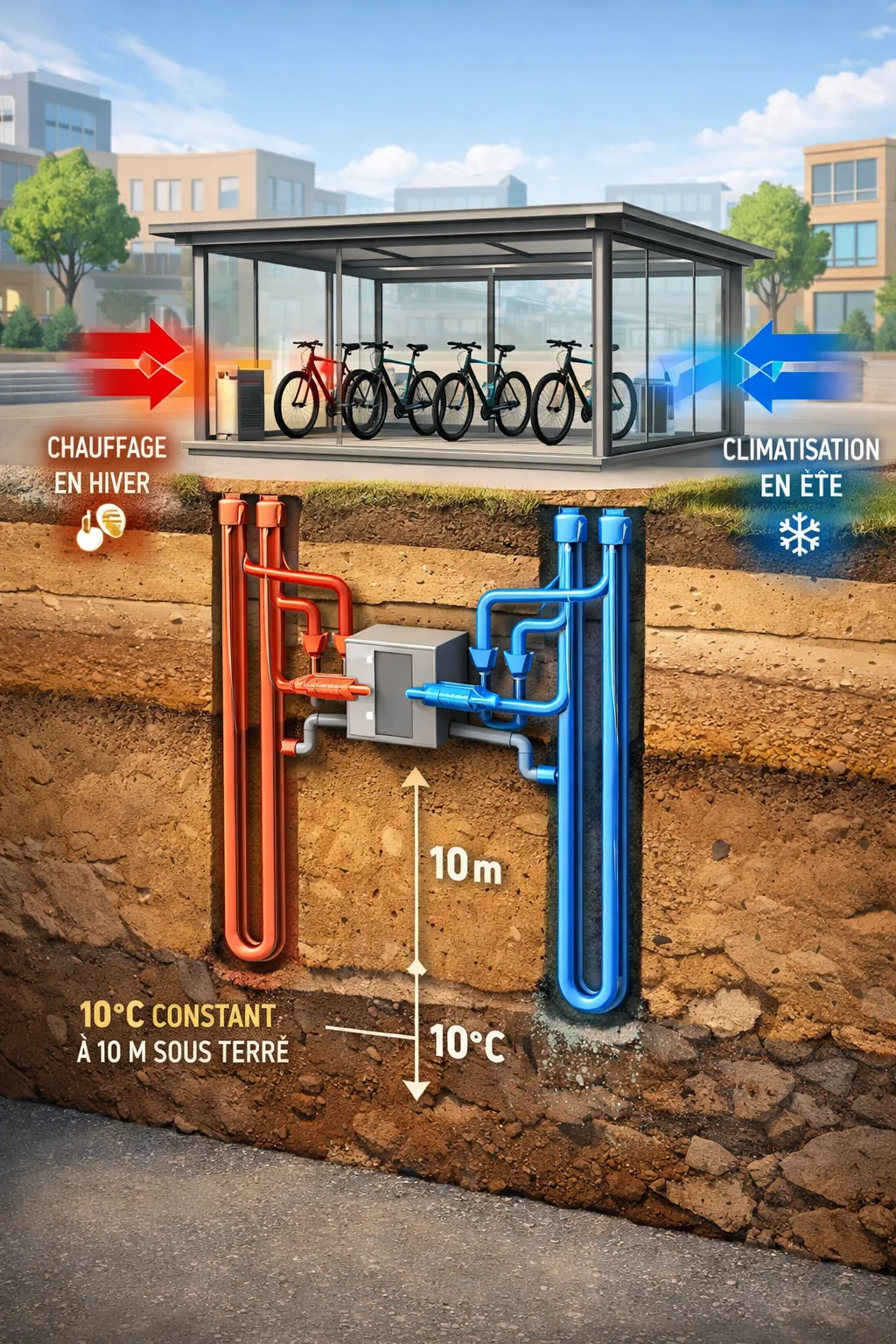
A project that is both revolutionary and common-sense.
Revolutionary in its boring technology and its ambition. Common-sense in its means — the bicycle — and in its cost, among the lowest in its category. An economical, eco-friendly, safe network, open 24/7 and useful 365 days a year. For Québec City, the opportunity to become the first city in the world to build such a network.